25g, 50g or 100ml? How Serving Size Changes a Functional Jelly Formula
A 25g jelly stick and a 100ml squeezable pouch are not simply different package sizes. Serving size can change ingredient concentration, texture, flavor, consumer experience and formulation feasibility. Here is what private-label brands should consider before choosing a format.
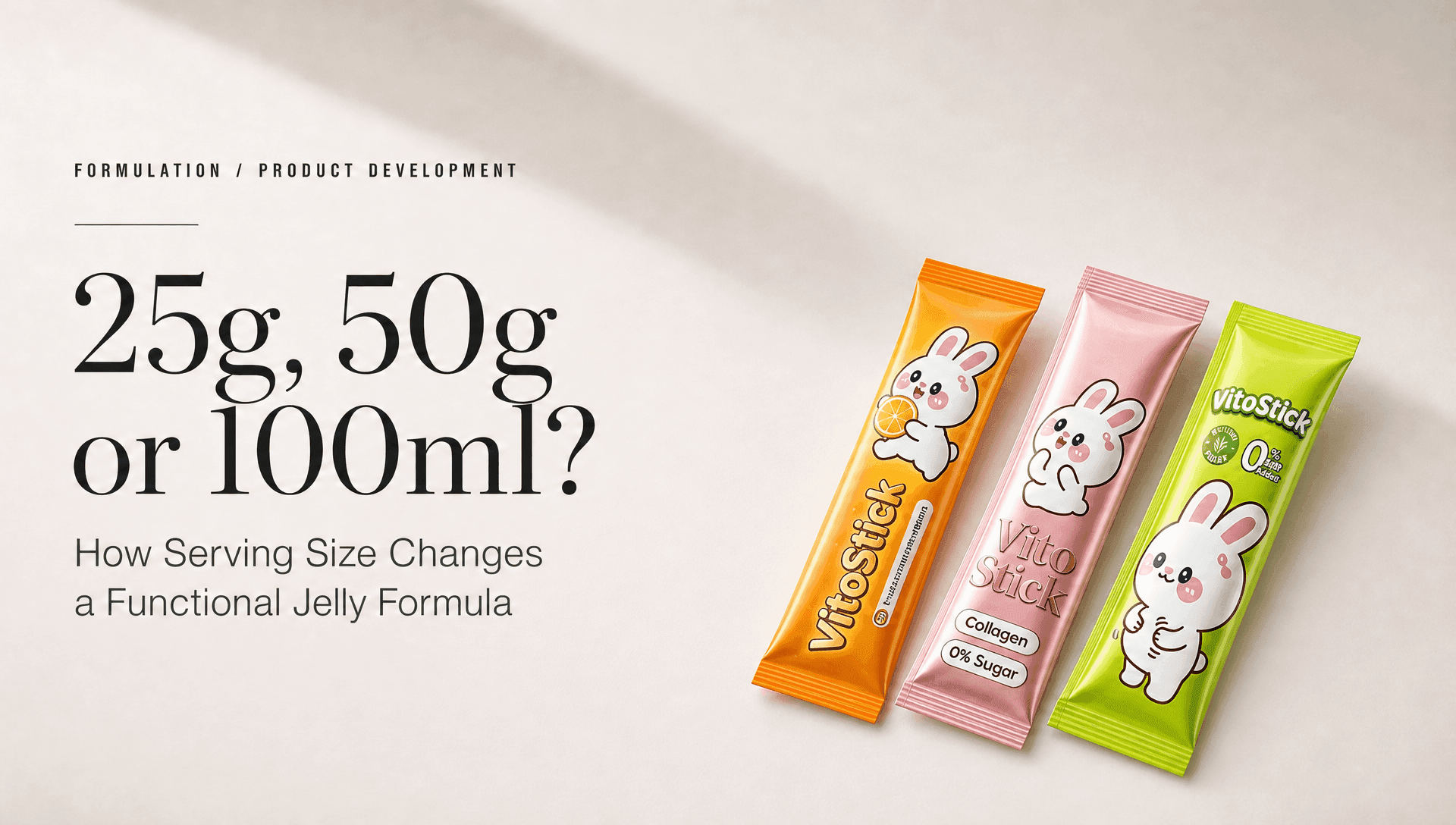
25g, 50g or 100ml? How Serving Size Changes a Functional Jelly Formula
Choosing between a 25g jelly stick, a 50g serving and a 100ml squeezable pouch is not only a packaging decision. Serving size can change ingredient concentration, sweetness, acidity, texture, flavor intensity, squeezability and the overall feasibility of a functional jelly formula.
For private-label brands, it is tempting to choose the package first.
A small stick looks convenient.
A larger pouch looks more substantial.
A 100ml format creates more space for branding.
But functional jelly development works differently from simply pouring the same product into three different containers.
The better question is:
What does the product need to deliver per serving—and what serving size allows that formula to remain enjoyable and commercially practical?
That question should come before final packaging decisions.
Why Serving Size Is Part of Formulation
Imagine two products that both need to deliver the same target amount of a functional ingredient.
One contains 25g of finished product.
The other contains 100ml.
Even before considering the exact ingredient, the concentration required in the smaller serving will generally be higher.
That difference can influence the complete sensory system.
Depending on the formula, higher concentrations of functional ingredients may affect:
- viscosity;
- gel strength;
- bitterness;
- acidity;
- sweetness;
- aftertaste;
- aroma;
- color;
- squeezability.
This is why a formulation that performs well in a larger pouch may need adjustment before it can work in a compact jelly stick.
Serving size determines the space in which the formula has to work.
1. Start With the Target Per Serving
The first question should not be:
Should we make a 25g stick or a 100ml pouch?
Start with:
What does one serving need to contain?
For a conventional fruit jelly, this question may be relatively simple.
For functional products, brands may have targets involving dietary fiber, collagen, carbohydrates, electrolytes, vitamins or other permitted ingredients.
The intended amount per serving matters because the ingredient must coexist with:
water + flavor + sweetening system + acids + hydrocolloid system + other ingredients.
If the target ingredient load is high relative to the serving size, R&D may have less room to optimize texture and flavor.
This does not automatically mean a small serving cannot work.
It means the serving size and functional target need to be evaluated together.
2. When Does a 20–30g Jelly Stick Make Sense?
Small jelly sticks are attractive because they are compact, portable and easy to position as a daily routine.
They can work particularly well when the product concept is:
- portion-controlled;
- convenient;
- easy to carry;
- designed for one quick consumption occasion;
- compatible with the intended ingredient target.
A small stick can also support a supplement-like brand architecture.
Consumers can understand:
one stick = one serving.
But the smaller format creates less formulation space.
If a brand wants multiple functional ingredients at relatively high amounts, the formula can become concentrated.
That may make taste or texture management more challenging depending on the ingredients.
The right development question is therefore not:
“Can we fit the ingredients into 25g?”
It is:
“Can we create a 25g product consumers will actually enjoy while meeting the intended specification?”
Those are different standards.
3. What Changes Around 40–60g?
A medium serving can provide more room between compact supplement-style formats and larger squeezable products.
For some concepts, this may allow brands to deliver a more snack-like experience.
Instead of a quick functional dose, the product can begin to feel like an actual food.
That distinction affects positioning.
A smaller stick may communicate:
daily wellness routine.
A larger jelly serving may communicate:
functional snack.
Neither is inherently better.
The correct choice depends on what the consumer is supposed to believe they are buying.
This is also where portion perception becomes important.
Brands should consider whether the serving feels appropriate for the intended occasion rather than selecting weight only according to manufacturing convenience.
4. Why 80–100ml Pouches Create Different Possibilities
A larger squeezable pouch creates a different product-development environment.
More total product volume can give R&D additional room to balance functional ingredients with flavor, sweetness, acidity and the hydrocolloid system.
It also creates a different consumption experience.
The product may be:
- squeezed gradually;
- consumed during activity;
- positioned as a portable snack;
- designed as a softer or more drinkable jelly;
- used for concepts where a larger serving feels natural.
For sports nutrition, for example, the serving format may need to consider carbohydrate or electrolyte targets alongside portability and ease of consumption.
For high-fiber or wellness products, a larger pouch may offer different formulation options than a small stick.
But larger is not automatically better.
A 100ml pouch also changes:
- package cost;
- carton efficiency;
- product weight;
- consumption time;
- perceived value;
- retail positioning.
The correct size is therefore a product strategy decision, not simply an R&D decision.
5. Ingredient Concentration Can Change Taste
Many brands think about functional ingredients primarily through nutrition targets.
R&D also has to think about them through sensory concentration.
Some ingredients may introduce:
- bitterness;
- mineral character;
- cereal or plant notes;
- chalkiness;
- sweetness;
- acidity;
- lingering aftertaste.
If the same target amount is placed into a smaller finished-product serving, those sensory characteristics can become more noticeable.
Flavor systems may therefore need to change with serving size.
A fruit profile that performs well in a larger pouch may need stronger aroma, different acidity or a modified sweetening system in a concentrated stick.
This is why flavor should not always be copied directly from one format to another.
6. Serving Size Can Change Texture Requirements
A 25g stick and a 100ml pouch may also be consumed differently.
A stick may need a texture that exits the package cleanly while still feeling like jelly.
A larger spouted pouch may benefit from a softer structure that can be squeezed comfortably through the opening.
A sports gel may prioritize easy swallowing during activity.
A snack jelly may deliberately create more chew.
These are different sensory targets.
Hydrocolloids therefore should not be treated only as ingredients that “make jelly.”
The gel system helps define how the consumer interacts with the product.
Package opening + serving size + viscosity + gel strength should be considered together.
7. Sugar Reduction Makes the Relationship Even More Important
Serving size becomes particularly relevant when the product also has sugar-reduction targets.
Sugar affects more than sweetness.
It can influence solids, flavor perception and the overall sensory experience.
Replacing or reducing sugar while simultaneously increasing functional ingredients creates multiple formulation variables at once.
That is why a zero-sugar 25g functional stick should not automatically be treated as a smaller version of a conventional 100ml fruit jelly.
The complete formulation may need to be rebuilt around the intended product specification.
This is also why early OEM feasibility discussions are valuable.
8. Serving Size Changes the Consumer Story
Formulation is only half of the decision.
The serving needs to make sense to the consumer.
Consider how differently these concepts feel:
25g Beauty Jelly Stick
A compact daily ritual.
50g Fiber Jelly
A convenient functional snack.
100ml Squeezable Wellness Jelly
A more substantial on-the-go product.
The functional ingredients could overlap, but the perceived product is different.
Serving size influences:
- usage occasion;
- price expectation;
- portability;
- satiety perception;
- packaging design;
- retail shelf presence.
This is why product positioning should be discussed before the final package is selected.
9. Do Not Choose Size Only From a Competitor Sample
Benchmark products are extremely useful during OEM development.
But copying the exact serving size of a competitor without understanding why that size was chosen can create problems.
A competitor may have:
- a different ingredient target;
- a different texture;
- different economics;
- another destination market;
- a different consumer occasion.
Use benchmarks to communicate the desired experience.
Do not assume every technical decision behind the benchmark should be copied.
A better brief might say:
We like the portability and soft texture of this 25g benchmark, but our formula needs a higher functional ingredient target. Please evaluate whether the same serving size remains appropriate.
That gives R&D room to solve the actual product problem.
10. How Should Brands Choose the Final Serving Size?
A useful decision sequence is:
1. Define the consumer.
Who will use the product?
2. Define the occasion.
Daily routine, sports, snacking, beauty, travel or another use?
3. Define the target per serving.
What must the finished product contain?
4. Define the sensory target.
Firm, soft, squeezable, drinkable or gel-like?
5. Evaluate concentration.
Can the intended ingredients work at the proposed serving size?
6. Evaluate packaging.
Which format supports the product experience?
7. Evaluate commercial practicality.
Does the final format make sense for target price, shipping and retail?
Only then should the size become fixed.
Serving Size Should Follow the Product—Not the Other Way Around
In functional jelly development, packaging and formulation are interconnected.
A smaller package can create convenience and strong portion control.
A larger serving can provide more formulation space and a different consumer experience.
Neither automatically produces a better product.
The best format is the one where:
Functional Target + Ingredient Concentration + Texture + Flavor + Consumer Occasion + Packaging
work together.
That is why brands should discuss serving size with their OEM manufacturer before finalizing artwork or purchasing custom packaging.
Developing Different Functional Jelly Formats With Victory Foods
Victory Foods (https://www.victoryfoodscn.com/?utm_source=chatgpt.com) develops hydrocolloid-based products across formats including functional wellness jelly, squeeze jelly drinks, konjac jelly and sports nutrition products. Its current product architecture includes compact functional jelly sticks as well as larger squeezable formats, giving private-label brands different starting points for product development.
An OEM/ODM discussion can begin with:
Target Consumer + Functional Target + Serving Size + Texture + Flavor + Packaging + Destination Market
and then evaluate whether those requirements work together as a commercial product.
Because the question is not simply:
“Which package can hold the formula?”
It is:
“Which serving size gives this formula the best chance to become a product consumers want to use?”
FAQ
Is 25g a common size for functional jelly sticks?
Small single-serve sticks around this general size can suit compact daily-use concepts, but there is no universal best size. The appropriate serving depends on the formulation, ingredient targets, consumer occasion and packaging.
Is a 100ml pouch better for high-fiber functional jelly?
A larger serving can create a different formulation environment for higher ingredient targets, but whether it is better depends on the specific fiber system, desired texture, flavor and product positioning.
Can the same functional jelly formula be used in different package sizes?
Not always without adjustment. Changing serving size or package format can change ingredient concentration, sensory perception, viscosity requirements and consumption behavior.
Should serving size be decided before functional jelly sampling?
A preliminary serving-size direction should be included in the product brief, but brands should remain open to R&D feedback if the functional targets and sensory requirements suggest another size would perform better.
What information should I give an OEM manufacturer about serving size?
Provide the proposed serving size, functional ingredient targets per serving, desired texture, flavor, sugar positioning, package preference, target consumer, destination market and expected retail positioning.