Private Label vs. Custom Formula: Which OEM Route Fits Your Functional Food Brand?
Private label and custom formulation can both bring a functional food product to market, but they solve different business problems. Learn how brands should compare development speed, differentiation, formulation control, packaging and commercial risk before choosing an OEM/ODM route.
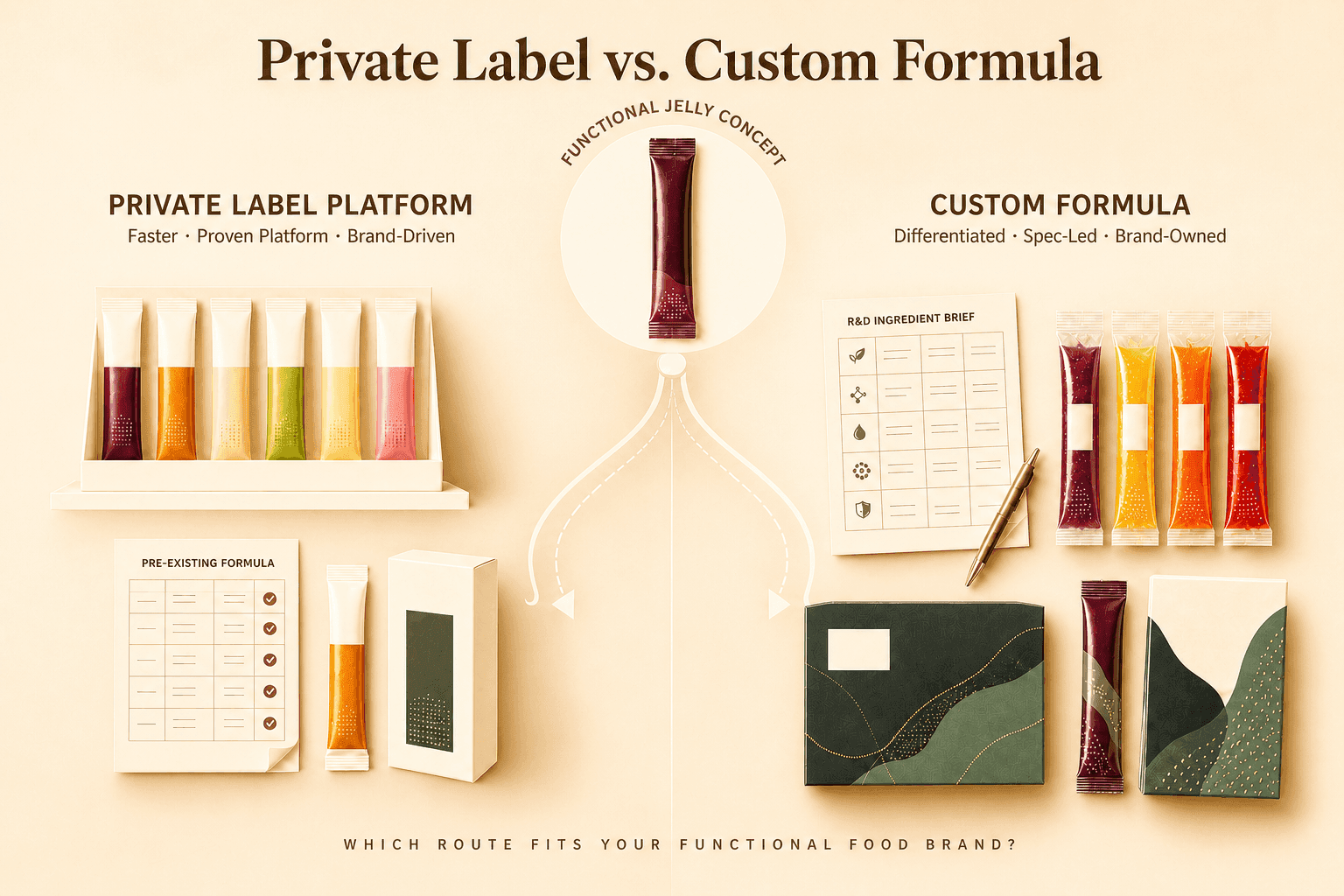
Private Label vs. Custom Formula: Which OEM Route Fits Your Functional Food Brand?
An existing private-label formula is usually better when speed, lower development complexity and market testing are the priority. A custom formula makes more sense when the product needs meaningful differentiation, specific ingredient targets, a distinctive sensory profile or a brand-owned product concept.
Neither route is automatically better.
The correct choice depends on what the brand is trying to achieve.
A startup testing its first wellness SKU may have very different priorities from an established sports nutrition company developing a product around precise carbohydrate and electrolyte targets.
That is why the first OEM conversation should not begin with:
“How much does private label cost?”
It should begin with:
“How much of this product actually needs to be unique?”
That question determines how much formulation, sampling and commercial development the project may require.
What Does “Private Label” Actually Mean?
In practical B2B product development, private label usually means a manufacturer already has a mature product platform that can be adapted for another brand.
Customization may still be possible.
Depending on the manufacturer and product, the buyer may be able to change:
- flavor;
- sweetness;
- color;
- package design;
- serving size;
- selected ingredients;
- secondary packaging.
However, the fundamental product platform is already established.
For a functional jelly, that might mean beginning with an existing jelly texture and manufacturing process rather than developing the complete hydrocolloid system from zero.
This can reduce the number of early development variables.
What Is a Custom Formula?
A custom formula begins with the buyer's specific product requirements rather than an existing finished concept.
For example, a brand may request:
A 30g beauty jelly stick with a specific collagen target, selected vitamins, a zero-sugar positioning, soft squeezable texture and a particular fruit profile.
Or a sports nutrition brand may require:
An energy gel with defined carbohydrate, sodium and potassium targets, a specific serving size and no caffeine.
In those cases, formulation decisions are being built around the buyer's specification.
That usually requires more R&D evaluation.
The manufacturer may need to balance:
Ingredient Targets + Serving Size + Flavor + Sweetness + Acidity + Texture + Processing + Packaging
as one system.
1. Private Label Is Usually Faster to Start
The clearest advantage of an existing platform is development efficiency.
If the manufacturer already understands how the base formula behaves, the buyer is not starting from a blank page.
The project can focus more quickly on decisions such as:
flavor;
branding;
package artwork;
serving format;
selected adjustments.
This can be useful for brands that want to test demand before investing heavily in product differentiation.
It is also useful when the main competitive advantage comes from:
branding + distribution + audience + positioning
rather than proprietary formulation.
A strong brand does not always require a completely new recipe.
2. Custom Formulation Creates More Differentiation
The main reason to choose custom development is control.
A custom project allows the brand to begin with questions such as:
- What consumer problem are we targeting?
- Which functional ingredient should be central?
- What amount should one serving contain?
- What sugar strategy do we want?
- What texture should distinguish the product?
- What consumption occasion are we designing for?
This creates more opportunity for the finished product to reflect the brand strategy.
For example, two beauty jellies could both contain fruit flavor and functional ingredients but feel completely different.
One might be:
premium + smooth + lightly sweet + 20g daily stick
while another might be:
larger + juicy + snack-like + 80ml pouch.
Custom formulation allows those decisions to become part of the product itself.
3. More Customization Means More Development Variables
Customization creates opportunity.
It also creates work.
Every additional requirement can interact with the rest of the formula.
For example, a buyer may request:
high fiber + zero sugar + small serving + very soft texture + strong fruit flavor.
Each request sounds reasonable individually.
Together, they create a more complex formulation problem.
The fiber system may affect viscosity.
Sugar reduction can change sweetness and overall sensory balance.
A small serving may increase ingredient concentration.
Texture requirements affect the hydrocolloid system.
This is why highly customized development may require more than one prototype round.
The purpose of R&D is not simply to “add the requested ingredients.”
It is to make the complete food product work.
4. Private Label Can Be Useful for Market Validation
A first product does not always need to become the brand's permanent hero SKU.
Sometimes the first objective is learning.
A brand may want to understand:
- whether consumers accept the format;
- which flavor performs better;
- whether the price point works;
- whether retailers will list the category;
- whether repeat purchase develops.
In this situation, beginning from a mature product platform can make strategic sense.
The brand can test the commercial idea first.
If demand becomes clearer, the next generation can become more customized.
This creates a useful development path:
Existing Platform → Market Test → Consumer Feedback → Custom Version
rather than attempting to perfect every detail before the first sale.
5. Custom Formula Makes More Sense When the Specification Is the Product
Some concepts cannot easily be separated from their technical specification.
Sports nutrition is a good example.
If an endurance brand needs specific carbohydrate or electrolyte targets per serving, those numbers are part of the product architecture.
Similarly, a fiber-focused jelly may have a defined fiber target.
A beauty brand may have specific functional ingredients it wants to build its positioning around.
In those cases, changing the formulation significantly could change the commercial concept itself.
Custom development therefore becomes more logical when:
the specification is part of the brand promise.
6. Packaging Does Not Automatically Make a Product Custom
This is an important distinction.
A product can have completely custom artwork and still use an established formulation platform.
Likewise, a product can have a highly customized formula while using a standard packaging structure.
Brands should separate:
Product Customization
from:
Brand Customization.
Brand customization can include:
- logo;
- colors;
- carton design;
- flavor naming;
- graphics;
- marketing language.
Product customization may include:
- ingredients;
- functional targets;
- sweetness;
- acidity;
- texture;
- serving size;
- flavor system.
Understanding this difference makes supplier discussions much clearer.
7. MOQ Should Not Be the Only Decision Factor
Startups often compare manufacturers primarily through MOQ.
MOQ matters.
But a low MOQ does not automatically make a development route commercially better.
Brands should also consider:
- sample-development requirements;
- custom ingredient purchasing;
- packaging minimums;
- artwork setup;
- testing;
- production efficiency;
- landed cost.
For example, a highly customized formulation may require a specialized functional ingredient with its own supplier minimum.
Even if the finished-product production MOQ appears manageable, the ingredient or printed packaging may create another commercial constraint.
This is why buyers should ask about the complete project—not one MOQ number.
8. Which Route Is Better for a Startup?
For many first-time brands, the safest route is not automatically “private label.”
It depends on why the brand exists.
If the concept is primarily:
“We want to launch a functional jelly brand and test consumer response.”
an established platform may be a logical starting point.
But if the brand was created around a very specific product idea, such as:
“We need a particular fiber system, serving target and texture that existing products do not offer.”
then excessive compromise may remove the reason the product exists.
A useful startup question is:
What must be unique on Day One, and what can be improved in Version Two?
That prevents unnecessary R&D without sacrificing the core proposition.
9. Which Route Is Better for Established Brands?
Established brands often have more information.
They may already know:
- their target consumer;
- successful flavors;
- acceptable retail price;
- preferred packaging;
- key nutrition claims;
- distributor requirements.
That can make custom development more efficient because the product brief is clearer.
An established brand may also be using OEM development specifically to fill a portfolio gap.
For example:
a supplement company adding functional jelly;
a sports nutrition company adding an energy gel;
a beverage brand exploring popping boba;
a wellness brand extending into beauty jelly.
In these cases, customization can help the new format remain consistent with the existing brand architecture.
10. OEM, ODM and Private Label Are Related—but Not Identical
These terms are sometimes used interchangeably in commercial discussions, but the practical distinction is useful.
OEM generally emphasizes manufacturing a product to the buyer's requirements or specification.
ODM generally involves more manufacturer-led development, where R&D capabilities help turn the buyer's concept into a manufacturable product.
Private label describes a product sold under the buyer's brand and may involve either a relatively established product platform or meaningful customization.
In real projects, the boundaries can overlap.
What matters more than terminology is understanding:
Who defines the formula? How much development is required? What can be customized? What has already been validated?
Those questions are more useful than arguing over labels.
A Practical Decision Framework
Choose an existing/private-label platform when your priority is:
- faster market entry;
- testing a new category;
- lower development complexity;
- strong branding over formula differentiation;
- working from a proven product format.
Choose custom formulation when your priority is:
- specific functional ingredient targets;
- unique nutrition specifications;
- differentiated texture or flavor;
- stronger product-level differentiation;
- a concept that cannot be delivered by the existing platform.
A third route is often the most practical:
Start From a Mature Platform + Customize the Variables That Matter Most.
This hybrid approach can give brands differentiation without rebuilding every technical element from zero.
Why This Question Matters Right Now
Vitafoods Asia 2026, taking place in Bangkok from September 2–4, 2026, includes a dedicated Contract Manufacturing & Private Label sector. The event positions product development, packaging, analysis, testing and regulatory services alongside manufacturing—reflecting how modern functional-food sourcing increasingly involves a complete development system rather than simply finding factory capacity.
Recent exhibitor profiles also show contract manufacturers presenting custom formulation, private-label solutions and multiple delivery formats to health and wellness brands at the show.
The timely signal is clear:
Brands are not only shopping for products. They are shopping for development models.
That is the part worth carrying into an evergreen sourcing strategy.
Developing Private-Label and Custom Functional Foods With Victory Foods
Victory Foods China develops OEM/ODM hydrocolloid-based products across functional wellness, konjac jelly, squeeze jelly, freezer pops and sports nutrition. Its current portfolio includes both established product platforms and products where formulation variables such as ingredients, texture, flavor and packaging can be developed around buyer requirements.
A useful first inquiry should define:
Target Consumer + Product Function + Must-Have Ingredients + Serving Size + Texture + Flavor + Packaging + Destination Market
Then ask one final question:
Which parts of this concept truly need customization?
That question can save development time while preserving the product elements that create genuine differentiation.
The best OEM route is not necessarily the most customized route.
It is the route that matches the business strategy.
FAQ
Is private label the same as OEM?
Not exactly. Private label describes selling a product under your own brand, while OEM generally refers to manufacturing according to buyer requirements. A private-label project may use an established formula or involve custom OEM/ODM development.
Is custom formulation more expensive than private label?
It can involve more development work, especially when specialized ingredients, repeated prototypes, custom packaging or additional validation are required. Actual commercial cost depends on the specific project rather than the label “custom.”
Should a startup use an existing formula?
An established platform can be useful when the goal is to test a category quickly. However, if a specific formulation is central to the brand proposition, custom development may still make sense for a startup.
Can I customize flavor and packaging without changing the base formula?
Often yes, depending on the manufacturer and product platform. Brands should ask which variables can be changed without rebuilding the complete formulation.
What should I send an OEM/ODM manufacturer before requesting a quotation?
Provide the product category, target consumer, ingredient or nutrition targets, serving size, flavor, texture, packaging preference, destination market and estimated order volume.