How to Build a Functional Jelly Packaging Incoming Inspection Plan
Approving a packaging component does not prove that every delivered lot is correct. This guide shows functional jelly buyers and manufacturers how to turn approved specifications, artwork and reference samples into a risk-based incoming inspection plan covering identity, supplier and lot details, delivery condition, documents, sampling, appearance, dimensions, print, status control, deviations and traceability.
How to Build a Functional Jelly Packaging Incoming Inspection Plan
Approving a packaging component and inspecting an incoming packaging lot are related activities, but they answer different questions.
Component approval defines what the project is allowed to purchase and use. It may identify a supplier, material construction, dimensions, artwork version, functional requirements, supporting documents and approved reference samples.
Incoming inspection asks whether a specific delivery matches those approved references before the packaging enters production. The delivery may be correct, damaged in transport, mixed with another revision, printed from an obsolete file or supplied under an unapproved lot identity. A receiving decision therefore needs evidence tied to the actual shipment.
For functional jelly projects, this distinction matters because the package can affect product protection, filling and sealing operations, label accuracy, consumer use and brand presentation. A good incoming inspection plan does not invent one universal sample size or acceptance limit. It converts project-specific requirements into repeatable checks, records and material status decisions.
Separate Component Approval From Incoming Inspection
The approved packaging file establishes the expected component. The incoming inspection record establishes what arrived.
A component approval may cover a cup, lidding film, pouch, cap, carton, tray, label or shipping case. It can include the approved supplier, component code, drawing, material declaration, artwork file, color reference, closure or sealing requirements and any evidence needed for the destination market.
Incoming inspection should not reopen every development decision. It should compare the delivered lot with the controlled approval package and identify anything that requires investigation. If a new supplier, new material, new tooling or new artwork revision arrives without approval, the correct action is not to inspect it as though it were the approved component. The material should be placed under the applicable hold and change-control process.
This separation keeps receiving work practical. It also prevents a passed visual inspection from being treated as retrospective approval of an undocumented change.
Define the Scope of the Inspection Plan
Start by listing every packaging component covered by the plan. Do not use a single line called packaging if the finished item contains several parts with different risks.
A functional jelly cup may involve the cup, lidding film, printed label, spoon, tray, retail carton and transport case. A jelly stick may involve printed film, tear features, display carton and shipping case. A squeezable pouch may add a cap or fitment. Each component needs an identity and a defined inspection scope.
For every component, state whether the inspection applies to every lot, selected receipts or another justified frequency. Identify who receives the material, who performs the check, who reviews exceptions and who can change the status from quarantine to released or rejected.
The plan should also name the site and storage area. A contract manufacturer, packing partner and third-party warehouse may not use the same codes or status labels. The document should translate the approved project references into the system used at the receiving location without losing traceability.
Build the Plan From Approved References
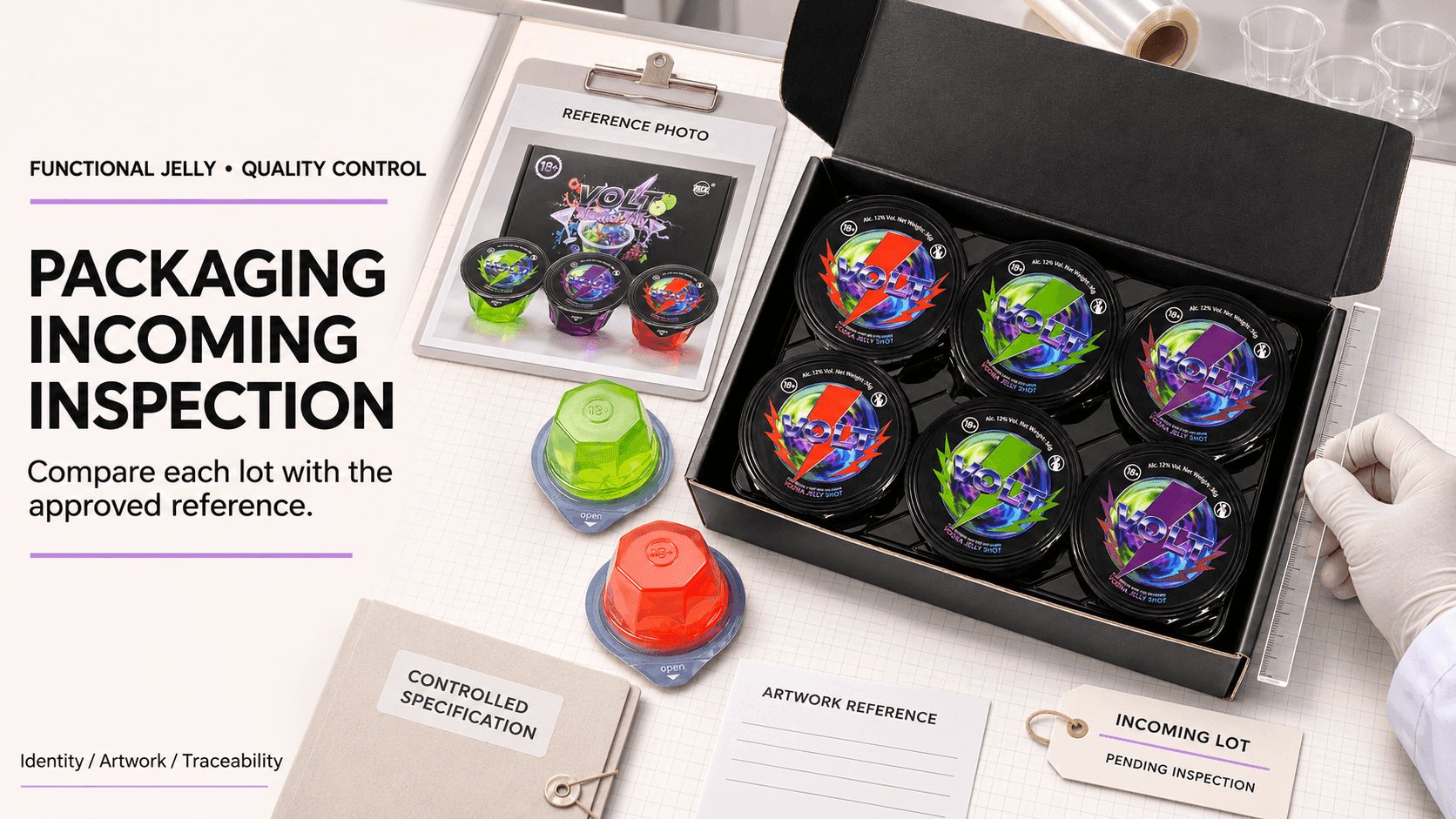
Incoming inspection needs controlled references that an inspector can actually access.
Useful references may include:
- component name and internal code
- supplier name and approved manufacturing site where relevant
- current specification number and revision
- drawing and approved dimensions
- approved material or construction reference
- approved artwork file and language version
- color standard or physical reference sample
- defined visual defect examples
- food-contact or other supporting documents required for the project
- approved inspection method and decision rule
The finished product specification for functional jelly can help connect the product version to its primary and secondary packaging references. The incoming inspection plan should not copy uncontrolled fragments from several files. It should point to the current source and state which characteristics are checked at receipt.
If an inspector cannot tell which file is current, version control has already failed. Remove obsolete proofs and samples from the inspection station or clearly mark them as superseded.
Confirm Delivery Identity Before Sampling
Identity checks should happen before packages are opened for detailed inspection.
Compare the purchase order, delivery documents, supplier label and internal component record. Confirm the component name, code, supplier, supplier site where controlled, quantity, delivery date, manufacturing or packaging lot, and revision information available on the shipment.
Check whether the delivery contains one lot or several lots. Mixed lots may need separate sample selection and separate decisions because a result from one lot does not automatically represent another.
Record any mismatch exactly as received. Do not silently rewrite a supplier code to make it fit the purchase order. A minor clerical difference may be resolved through documented review, but an unrecognized identity can also indicate the wrong component, wrong revision or loss of traceability.
Check Transport and Outer Packaging Condition
The first physical inspection begins with the shipment, pallet and outer containers.
Look for evidence of crushing, puncture, water exposure, contamination, open cartons, broken straps, displaced pallet wrap or other handling damage. Confirm that the material was protected from conditions that could make it unsuitable for its intended use.
Photograph relevant damage before the pallet is rearranged. Identify which cases or layers were affected and preserve the supplier and transport labels. A clean inner component should not automatically erase evidence of a compromised delivery, and one damaged case should not automatically condemn unrelated cases without an assessment.
The disposition should follow the defined quality process. The inspection plan can tell the receiver what to record and whom to notify; it should not predetermine the technical conclusion for every type of transport event.
Review Supporting Documents at Receipt
The required document set depends on the component and project.
The plan may call for a delivery note, lot or batch identification, certificate or declaration, quantity statement, artwork revision reference, inspection report or other agreed supplier document. Record whether each required item was received and whether it matches the shipment identity.
Do not treat the presence of a document as proof that the physical lot is correct. The document review and physical inspection support each other. A correct certificate attached to the wrong pallet is not useful, and a visually acceptable roll with no traceable lot may still require quarantine.
Food-contact support should be reviewed in the context of the destination market and intended use. The U.S. Food and Drug Administration, for example, explains that food packaging and its components can fall within the scope of food-contact substances. That information helps define why component identity and intended use matter, but it does not create one global document list or acceptance rule.
Choose a Risk Based Sampling Approach
Not every unit in a large packaging delivery can be checked in the same way. The sampling approach should reflect the decision the inspection is expected to support.
Consider the component risk, lot size, manufacturing process, supplier performance, change history, defect detectability, inspection method and consequence of an error. Printed film with a new language version may need different attention from a familiar unprinted shipping case. A component used in direct food contact may involve different documentation and controls from a secondary carton.
The ISO 2859 family provides recognized attribute-sampling systems, and ISO 28590 introduces those systems and guides selection for a particular situation. The existence of these standards does not justify copying an AQL, inspection level or sample size from another project. Qualified personnel should select and document a suitable system when statistical acceptance sampling is used.
The plan should explain how samples are distributed across the delivery. Selecting only the most accessible units from the top of one carton can miss variation across pallets, cases, rolls or production positions. Record where the samples came from so the result can be investigated later.
Define Defects Before the Inspector Finds Them
A useful plan describes unacceptable conditions before the shipment arrives.
The team may classify defects by their effect on safety, identity, function, label accuracy, production performance or appearance. The names critical, major and minor are sometimes used, but they have value only when the project defines what they mean and connects them to a decision rule.
Examples for discussion may include the wrong component, obsolete artwork, missing mandatory information, contamination, damaged food-contact surfaces, dimensions outside the approved specification, illegible codes, poor print registration or cosmetic marks.
Do not assume the same classification applies to every format or market. A small print shift may be cosmetic in one area and serious if it changes a warning, allergen statement or barcode. The controlled defect catalogue should show examples where practical and identify who can interpret an unfamiliar defect.
Inspect Appearance and Workmanship
Visual inspection should be structured rather than described as looks good.
Depending on the component, relevant observations may include cleanliness, foreign material, scratches, dents, pinholes, wrinkles, delamination, uneven edges, cracks, deformation, poor trimming, missing parts, inconsistent finish or damage to sealing and closure areas.
Compare the inspected units with the approved sample and specification. Use lighting and viewing conditions appropriate to the feature. If color is important, define the reference and method instead of relying on memory or a mobile phone image.
Record the location and pattern of a defect. Repeated marks in the same position may indicate tooling or printing variation, while random damage may point to handling. The pattern can help determine whether additional inspection, supplier investigation or production trial work is needed.
Verify Dimensions With Defined Methods
Dimensions should be checked only where they support fit, filling, sealing, assembly, label placement or another approved requirement.
The plan should identify the characteristic, drawing location, measurement tool, sample conditioning if relevant, method and applicable tolerance from the controlled specification. It should also state how results are recorded and how an out-of-specification result is confirmed.
Do not add a dimension simply because it is easy to measure. A long list of weakly controlled measurements can distract from the features that affect production and package performance.
Measurement systems also require control. An inspector needs a suitable tool, a clear reference point and training. Two people measuring a flexible film or formed cup differently can create apparent variation that comes from the method rather than the lot.
Check Printed Information and Artwork Version
Printed packaging needs both identity and content checks.
Confirm that the delivered item uses the approved artwork revision, language, product name, flavor, net content, barcode, ingredient and nutrition panels, warnings and other project-specific fields. The functional jelly label review checklist can help identify which approved text and layout elements must be protected before printing and checked when material is received.
Compare the physical print with the approved proof rather than with a previous production lot. A previous lot can itself contain an error or obsolete version.
Check print position, registration, legibility and completeness where these are part of the specification. Record any difference precisely. A missing punctuation mark and a wrong allergen statement should not be described by the same vague note such as print problem.
Review Variable Data Areas
Some packaging arrives preprinted with a reserved area for a production code, date or market-specific overprint. The incoming inspection should confirm that this area exists in the correct location and remains usable by the intended coding process.
If the supplier prints variable information before delivery, verify the content, format and relationship to the packaging lot or product version as specified. If the manufacturer applies the information during production, incoming inspection should not claim that the final code has passed before it exists.
The plan can check background contrast, clear space, coating or surface condition when these affect later coding. Actual line performance and code durability may require production or validation work beyond incoming inspection.
Protect Samples From Mix Ups
Inspection samples need their own identity control.
Mark the component, supplier, lot, receipt number, date and sample source. Keep opened and unopened samples separate where useful. Do not return a sample to a released pallet if the inspection process may have damaged or contaminated it.
Reference samples should be protected from fading, crushing, contamination and uncontrolled replacement. A printed master stored in direct light may change color and become a misleading comparison. Record when a reference was approved and when it should be reviewed or replaced.
If photographs are used, keep them with the inspection record and label them by lot and location. A photograph is helpful evidence but may not reproduce color or surface defects accurately enough to replace a physical reference.
Record Results by Packaging Lot
The inspection record should connect the decision to the material inspected.
Useful fields include receipt number, component code, supplier, supplier lot, quantity, date, purchase order, specification revision, artwork revision, sample locations, sample quantity, inspection methods, results, defects, photographs, document status, inspector and reviewer.
Record actual observations rather than only pass. If dimensions are measured, retain the results required by the plan. If defects are counted, identify their defined category. If no applicable check is performed, record not applicable or not inspected rather than leaving an ambiguous blank.
The record should be retrievable from both directions. A packaging lot should lead to its inspection result, and a finished product lot should be able to identify which packaging lots were used. This is one reason functional jelly manufacturer quality control should include packaging control and traceability, not only finished product testing.
Control Quarantine Release and Rejection Status
Material status must be visible and controlled from receipt through use.
New deliveries should enter the status defined by the site, such as pending inspection or quarantine. Only authorized personnel should release material after required checks are complete. Rejected or unresolved material should remain physically or electronically controlled so it cannot be selected for production by mistake.
Status labels, warehouse locations and inventory systems should agree. A green sticker on a pallet is not enough if the enterprise system still shows the lot as blocked, and a released system status is not enough if the pallet identity has been lost.
Partial release requires special care. If only part of a delivery is accepted, record the exact quantity and location. Prevent rejected cases or rolls from being recombined with released material.
Handle Deviations Without Informal Substitution
An incoming result outside the approved requirement needs a documented decision.
The plan should identify who reviews the deviation, what evidence is needed and which outcomes are available under the quality system. Possible outcomes may include rejection, additional inspection, supplier investigation, controlled concession or another approved disposition.
A concession should not be a verbal shortcut. It needs the affected lot, specific deviation, technical assessment, market and product impact, decision owner, expiry or one-time status, and any restrictions on use.
Do not use a production deadline as the acceptance criterion. If the delivered component differs from the approved version, determine whether it is a nonconforming lot or an unapproved change. Both require control before use.
Link Packaging Lots to Finished Product
Incoming inspection is only one point in the packaging control chain.
After release, warehouse issue records should preserve the component and lot identity. Production records should capture which packaging lot was used for each functional jelly batch or finished product lot. Reconciliation can help identify unexplained losses, mix-ups or leftover material.
If a complaint later concerns leakage, print, opening or code legibility, the team should be able to retrieve the incoming result, supplier lot, production use and related finished lots. The same traceability supports targeted investigation when a supplier reports a potential packaging issue.
Traceability does not prove that a package performed correctly. It makes the evidence and affected scope easier to find.
Adjust Inspection After Changes and Performance Data
An incoming plan should not remain static while the product and supplier system change.
Review the plan after a new supplier, material, tool, artwork, manufacturing site or significant process change. Also review it after repeated defects, complaints, line problems, transport damage or periods of demonstrated supplier performance.
Changes in inspection frequency or sample size should follow documented risk review and the selected sampling system. Reducing inspection because recent lots passed may be reasonable in some systems, but it should not happen informally. Increasing inspection can help contain uncertainty, but it does not replace root-cause work or supplier corrective action.
Trend records by supplier, component and defect type can show whether the plan is detecting meaningful problems. The objective is not to maximize inspection activity. It is to maintain confidence that released material matches the approved packaging system.
Separate Incoming Inspection From Package Performance Validation
Receipt inspection cannot answer every packaging question.
It can confirm identity, condition and selected characteristics of the delivered component. It may identify visible or measurable differences. It does not by itself prove food-contact suitability for every market, seal performance on the production line, barrier performance, migration compliance, distribution durability or shelf-life protection.
Those questions may require supplier evidence, regulatory review, line trials, seal or closure studies, distribution work and shelf-life validation. The functional jelly shelf life validation plan should evaluate the final formula, manufacturing process, package and intended supply chain as one defined system.
Keep these activities connected but separate. A package lot can pass incoming inspection and later fail on the line. A package can perform well on the line yet use obsolete artwork. Each control has a different purpose.
Review the Plan Before the First Commercial Receipt
Run a desk review before the first shipment arrives.
Confirm that the component codes, supplier names, specifications, drawings, artwork files, reference samples, methods, tools, defect definitions, sample selection instructions, records and status labels are ready. Walk through what happens when a result is unclear or the supplier sends a mixed lot.
Then test the plan with a real or representative delivery. An instruction that looks clear in a document may be difficult to apply on a pallet, roll or carton. Capture questions and revise the controlled plan before routine use.
The final plan should let a trained inspector reach a documented decision without guessing which revision is correct or inventing a threshold at the receiving dock.
Frequently Asked Questions
Is packaging component approval the same as incoming inspection
No. Component approval defines the allowed supplier, specification, artwork and supporting requirements. Incoming inspection determines whether a specific delivered lot matches those approved references before use.
Should every packaging lot use the same sample size
Not automatically. Sampling should reflect the selected system, component risk, lot size, supplier history, change status, defect type and intended decision. Do not copy a sample size or AQL from another project without justification.
Can a visual inspection prove food contact compliance
No. Visual inspection can identify condition and selected defects. Food-contact suitability and legal compliance require appropriate documentation and destination-market review for the material and intended use.
What happens if the artwork version is wrong
Place the affected lot under the applicable hold or quarantine process and investigate before use. Do not treat an obsolete artwork version as a cosmetic issue without assessing label accuracy and market impact.
Does passing incoming inspection prove shelf life
No. Shelf life relates to the final formula, process, package, storage and distribution system. Incoming inspection is one control over packaging identity and condition, not a complete package validation study.
What should be traceable after production
The business should be able to connect the received packaging lot and its inspection decision to warehouse issue and the relevant finished product lot. The exact record structure depends on the manufacturer's quality system.
Brands, importers and manufacturing teams can review a packaging inspection plan together before the first commercial functional jelly delivery is accepted.