Popping Boba Packaging for Retail Foodservice and Ready to Drink Products
The right popping boba package depends on where the product will be sold and how it will be used. This buyer guide compares bulk foodservice packs, retail topping formats, ready-to-drink cups and snack packs across operations, labeling, shelf life and logistics.
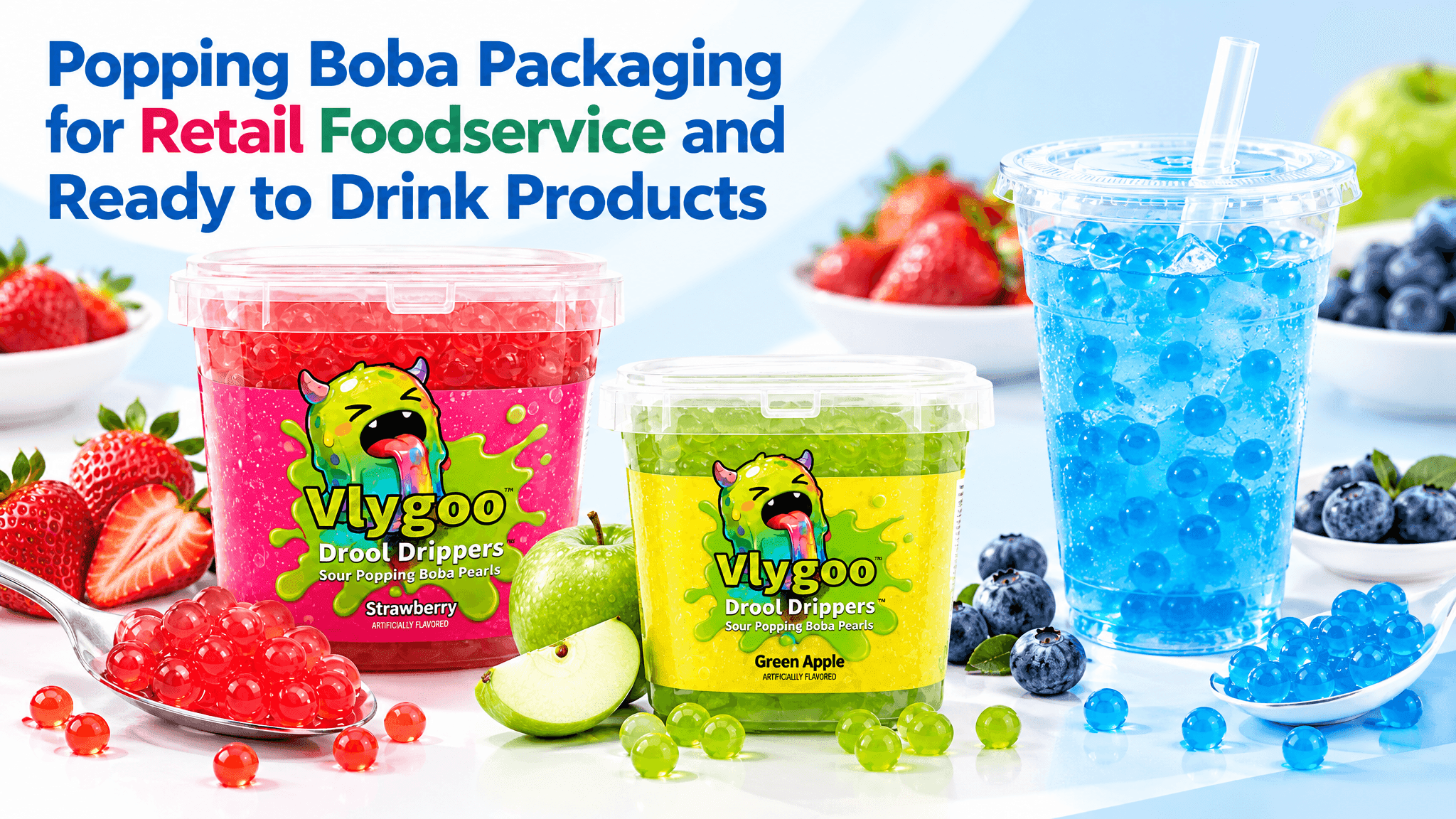
Popping Boba Packaging for Retail Foodservice and Ready to Drink Products
Popping boba can appear in a bubble tea shop, a retail topping kit, a ready-to-drink fruit beverage or a snack product. The pearls may look similar, but the commercial package should not be.
The first packaging question is often:
Which container has the lowest unit cost?
A stronger starting question is:
How will the customer store, open, portion, sell and consume the product?
Packaging affects more than appearance. It influences filling compatibility, portion control, label space, handling after opening, carton efficiency, leakage risk and the number of sellable SKUs. A package designed for a busy beverage counter has different priorities from one intended for a supermarket shelf or an e-commerce parcel.
This guide compares the main commercial routes and explains what buyers should define before requesting a private-label or OEM quotation.
1 Start With the Sales Channel
The same popping boba concept can support several business models:
- a bulk topping used by cafes, dessert shops or restaurants
- a consumer topping pack sold through grocery or online retail
- a ready-to-drink cup with beverage and pearls in one unit
- a portable snack or confectionery-style product
- a multi-component kit containing pearls and another food or drink base
Each model changes the job of the package.
Foodservice operators may prioritize fast opening, clean scooping, resealing and predictable servings. Retail buyers may prioritize shelf impact, tamper evidence, label compliance and barcode management. Ready-to-drink products need the pearls, liquid, opening system and drinking experience to work as one product. E-commerce adds parcel handling and leakage exposure that may not appear in a retail-shelf test.
Before choosing a container, write one sentence that describes the actual use occasion. For example:
A cafe employee will open one package, portion it across multiple drinks during service and store the remainder according to the approved instructions.
or
A consumer will buy one ambient retail cup, open it once and drink the beverage and popping boba together.
That sentence gives the manufacturer a more useful starting point than a request for a generic popping boba package.
2 Bulk Foodservice Packs Focus on Operations
Foodservice packs are intended to supply multiple servings. Depending on the product and supplier, the commercial route may involve tubs, pails, jars, pouches or other suitable containers.
The best option is not automatically the largest one. Buyers should evaluate:
- expected servings per package
- sales volume during a normal service period
- how staff will open and reseal the container
- how pearls will be scooped or dispensed
- storage space before and after opening
- product loss from spills or unused remainder
- cleaning and cross-contamination controls at the outlet
- the approved after-opening storage and use instructions
A package that is too small may increase handling and packaging waste. A package that is too large may remain open longer than the operating plan allows or may be awkward for staff to lift, store and portion.
Serving yield is therefore a better planning metric than gross pack weight alone. A buyer should estimate the pearl quantity used per drink, calculate the expected servings, and compare that result with realistic daily sales.
The supplier must confirm the actual storage conditions and usable period for the approved product. Buyers should not transfer instructions from another brand or assume that all popping boba formulas behave the same way after opening.
3 Retail Topping Packs Need a Complete Consumer Experience
A retail topping product transfers tasks from trained staff to the consumer. The package must explain what the product is, how to use it and how to store it.
Possible retail concepts include:
- a single-use topping cup
- a resealable multi-serve container
- a pouch designed to pour or spoon
- a kit containing popping boba and a beverage, dessert or flavor component
- a variety pack with several flavors
The buyer should decide whether the product is a stand-alone topping, part of a kit or an ingredient for a specific recipe. That decision affects the name of the food, serving information, instructions, graphics and the amount of label space required.
Consumer convenience should be tested physically. Can the package be opened without tools? Does the opening allow pearls and liquid to dispense cleanly? Can a multi-serve pack be resealed as intended? Are the storage instructions visible after opening? Does the package remain stable in a home refrigerator or pantry under the labeled conditions?
Retail packaging also carries the brand promise. Transparent areas can display color and texture, while opaque or printed surfaces provide more graphic control. The design should balance product visibility with the material and barrier structure required for the approved product.
4 Ready to Drink Cups Must Be Designed as One System
In a ready-to-drink popping boba product, the beverage, pearls, cup, lid, seal and opening method create one consumption system.
The project team should evaluate:
- whether the pearls move freely enough for the intended drinking method
- the relationship between pearl diameter and straw or opening size
- the liquid-to-pearl ratio
- how the product is mixed before consumption
- whether the consumer needs a separate straw or utensil
- seal performance during transport
- headspace and product movement
- cup stability in retail display and transit cartons
The package cannot be selected independently from the formula. Beverage viscosity, acidity, suspended fruit pieces, pearl size and the intended fill can all affect the experience.
A concept such as a Panda Popping Cup illustrates the ready-to-drink route: the package is part of the product proposition, not simply a container added after formulation.
Brands should approve the drinking experience with realistic samples. A visually attractive cup can still fail if the pearls block the opening, the straw is uncomfortable, the beverage separates in an unexpected way or the consumer cannot understand how to use it.
5 Snack Packs Create Different Portion and Positioning Questions
Popping boba can also be positioned closer to a snack, candy or interactive texture experience rather than as a cafe topping.
This route changes the questions buyers should ask:
- Is the product consumed directly or added to another food?
- Is one package one serving or several servings?
- Does the consumer drink the surrounding liquid?
- Is a spoon, straw or nozzle required?
- How will the product be merchandised?
- is the product aimed at children, teenagers or adults?
- What warnings, instructions or age-positioning review may be appropriate in the target market?
A product such as Drool Drippers Sour Popping Boba demonstrates how texture, flavor intensity and package interaction can become part of the snack concept.
The pack format should still be assessed as a food package first. Novel shapes and interactive openings need the same attention to seal integrity, clean use, label area and market suitability as a conventional cup or pouch.
6 Pack Size Should Follow Serving Yield and Use After Opening
Pack size is not only a merchandising decision. It connects sales velocity with product handling.
For foodservice, estimate the quantity used per serving, expected daily sales, number of service days represented by one package, storage and handling after opening, and likely waste or loss.
For retail, define whether the pack is single use or multi serve, the labeled serving size and servings per container, how consumers will measure or pour the product, whether the pack can be closed again, and the approved storage and use instructions after opening.
These calculations should happen before artwork begins. Changing net content later can affect the container, fill level, nutrition information, price architecture, carton count and product identification.
Buyers should request product-specific shelf-life support and after-opening instructions. Do not publish a storage period copied from a competitor or from an early sample that has not been approved for commercial production.
7 Product and Package Compatibility Must Be Verified Together
Popping boba contains a delicate outer membrane and a liquid center. The pearls are held in a surrounding liquid or finished beverage, depending on the concept. The package must support the approved formula throughout filling, transport, storage and use.
Compatibility questions may include:
- whether the package material is suitable for the food and process
- how seals perform with the intended fill and product residues
- whether the container tolerates expected distribution conditions
- whether light or oxygen exposure is relevant to color or flavor
- whether the opening damages the pearls during dispensing
- whether the package maintains its shape when stacked
- whether ink, adhesive and food-contact layers are used as intended
The US Food and Drug Administration explains that it regulates substances that come into contact with food as well as ingredients added directly to food. Buyers selling in other markets should identify the relevant packaging and food-contact requirements there.
Compatibility should be reviewed during development and confirmed with the commercial package, not only with a laboratory cup. The sample-to-mass-production process should include package approval, production observations and the validation appropriate to the finished product.
8 Label Space Is a Product Requirement
Small cups and shaped packs may provide limited printable area. That limitation should be considered before the brand commits to a format.
A prepacked retail product may need space for information such as:
- the name or identity of the food
- net quantity
- ingredient and allergen information
- nutrition information where required
- responsible business details
- date coding and lot identification
- storage conditions
- instructions for use
- country-of-origin information where applicable
- market-specific language or importer information
The exact requirements depend on the product and destination. The FDA Food Labeling Guide summarizes general US label statements, while the European Commission lists mandatory information for prepacked foods in the EU, including special storage conditions and instructions where relevant.
These sources are starting points, not a substitute for qualified review of the actual product. A multi-market launch may require different language, declarations, responsible-party information or artwork versions.
Label content should be reviewed before custom packaging is printed. A late change to net content, ingredients, serving information or instructions can make printed material unusable.
9 Every Pack Configuration Creates SKU Decisions
A brand may begin with one flavor and quickly add:
- another flavor
- a different pack size
- a variety pack
- a foodservice version
- a retail single serve version
- a ready-to-drink version
- a market-specific label
Each combination can become a separate commercial item with its own artwork, product code, case configuration, forecast and inventory.
GS1's GTIN Management Standard helps brand owners make consistent decisions about identifying trade items. Changes such as declared net content, pack or case quantity, and new product introductions can affect identification decisions.
The operational lesson is simple: packaging variety creates inventory variety.
Before launching several formats, decide which channel has the clearest demand. A focused first range may be easier to forecast and replenish than many low-volume configurations sharing the same total order quantity.
10 Secondary Packaging and Shipping Need Equal Attention
The consumer container is only the first packaging layer. Buyers should also review:
- dividers or trays that protect primary packs
- master carton dimensions and gross weight
- case quantity and retailer requirements
- pallet pattern and stacking limits
- export markings and lot traceability
- temperature and handling instructions
- parcel protection for e-commerce
- leakage response and damaged-carton procedures
A cup that performs well on a shelf may still move, crack or leak when packed inefficiently in a master carton. A flexible pouch may need protection from sharp carton edges or compression. A heavy foodservice container may require a carton design that supports warehouse handling.
Shipping tests should reflect the intended route. The project team should consider factory handling, inland transport, export shipment, warehouse storage, retailer distribution and final delivery rather than testing only one isolated movement.
Container loading should not override product protection. The useful pack is the one that reaches the customer in saleable condition with appropriate remaining shelf life.
11 Compare Quotations on the Same Packaging Assumptions
Two popping boba quotations may not be comparable if they assume different package sizes, materials, print methods, cartons or quality activities.
Ask each supplier to confirm:
1.intended channel and use occasion
2.primary container type and nominal fill
3.single-use or multi-serve design
4.standard label or custom-printed packaging
5.packaging MOQ per artwork
6.units per retail pack and master carton
7.included accessories such as straw or spoon
8.shelf-life and storage assumptions subject to validation
9.testing and documentation included or excluded
10.treatment of unused printed materials
11.lead-time assumptions for product and packaging
12.pallet or loading assumptions where available
Quality-control questions should cover the finished package as well as the pearls. Buyers can ask how seal checks, code verification, fill controls, traceability and release decisions are handled for the relevant product.
The quotation should describe the approved configuration clearly enough that the same package can be ordered again without relying on memory.
12 Use a Channel First Packaging Brief
A concise packaging brief can prevent weeks of misaligned samples.
Provide the manufacturer with:
Target market + Sales channel + Consumer or operator use + Product format + Serving or portion + Pack size direction + Opening method + Flavor count + Label languages + First order estimate + Launch date
Then ask the supplier to identify the decisions that still require technical confirmation.
The package should be approved against five tests:
- Usability: Can the intended person open, portion and consume it naturally?
- Compatibility: Does the package work with the approved formula and process?
- Compliance: Is there enough space and structure for target-market information?
- Distribution: Can the finished unit survive the planned handling route?
- Commercial fit: Does the pack support the channel, price architecture and reorder plan?
This framework keeps the discussion connected to the business model instead of reducing packaging to a container catalog.
Planning a Popping Boba Package With Victory Foods
Victory Foods China presents popping boba concepts including ready-to-drink cups and snack-oriented products on its public website, alongside beverage, jelly and other hydrocolloid-based product categories.
For an OEM or ODM discussion, buyers can prepare:
Target market + Channel + Popping boba use + Formula direction + Pack format + Net content + Flavor plan + Artwork route + First order estimate + Annual forecast
Victory Foods should confirm the feasible container, material, fill, printing route, validation plan, MOQ and lead time for the specific project. Package options and storage instructions must be based on the approved product and destination market rather than a general article.
FAQ
What is the best packaging for wholesale popping boba
There is no single best format. A foodservice buyer may prioritize multi-serve handling and resealing, while a retailer may need shelf impact, tamper evidence, consumer instructions and barcode-ready packs. Start with the sales channel and use occasion.
Should foodservice popping boba use the largest available pack
Not automatically. Compare servings per pack with outlet sales velocity, storage space, staff handling and the approved after-opening instructions. A larger pack can reduce packaging per serving but may increase handling or waste.
Can popping boba be packed inside a ready-to-drink beverage
It can be developed as a combined concept when the pearls, beverage, opening method and package are technically compatible. The manufacturer should verify the formula, pearl size, drinking experience, seal performance and shelf-life plan for the specific product.
Does each popping boba pack size need a different barcode
Different trade items may require separate identification. Brand owners should review GS1 GTIN rules for new products, net-content changes, pack quantities and assortments, then confirm retailer and market requirements.
What information should a buyer send before requesting a packaging quote
Provide the target market, channel, intended use, product format, portion or serving, pack-size direction, opening method, flavor count, label languages, first-order estimate and launch date. Ask the supplier to state all package and validation assumptions in the quotation.