From Sample to Mass Production: How a Private Label Functional Jelly Project Moves Through OEM Development
What happens after you contact a functional jelly manufacturer? Follow the typical OEM/ODM development path from product brief and prototype samples to packaging, validation and commercial production.
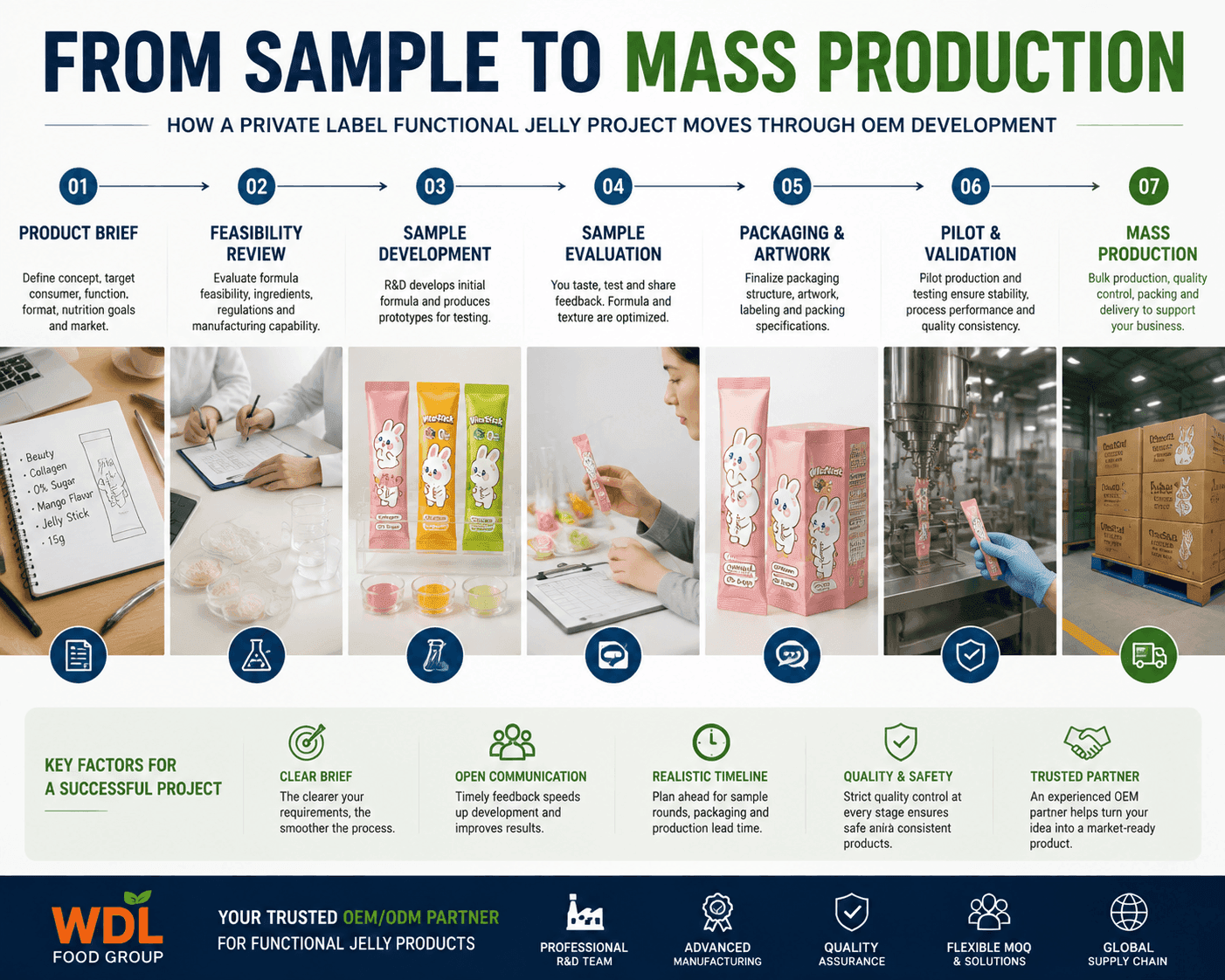
A private label functional jelly project usually moves through several connected stages: product definition, feasibility review, prototype development, sample evaluation, packaging alignment, commercial validation and mass production.
The exact process varies by manufacturer and product, but one principle is consistent:
Mass production should not begin until the formula, sensory experience, packaging and commercial requirements are aligned.
For first-time functional food brands, the development process can sometimes appear simpler than it really is.
A buyer contacts a manufacturer.
The manufacturer makes a sample.
The buyer approves it.
Production begins.
In practice, developing a commercial functional jelly involves more decisions.
A collagen jelly stick, electrolyte squeeze pouch, fiber jelly and sports energy gel may all use semi-solid formats, but their ingredients, textures, serving sizes, packaging requirements and processing considerations can be very different.
Understanding the development path helps brands prepare better information, reduce unnecessary revisions and communicate more effectively with an OEM/ODM manufacturer.
Stage 1: Define the Product Before Requesting a Sample
The first stage is not formulation.
It is product definition.
Before an R&D team can develop a meaningful prototype, the brand should explain what the finished product is intended to become.
A useful brief normally answers several questions.
Who is the consumer?
Is the product intended for:
- active consumers;
- women interested in beauty and wellness;
- children;
- endurance athletes;
- general healthy-snacking consumers?
What is the primary product function?
For example:
- fiber;
- hydration;
- energy;
- beauty-oriented nutrition;
- vitamin delivery;
- general wellness.
What is the desired format?
Possibilities may include:
- jelly stick;
- squeezable pouch;
- jelly cup;
- energy gel sachet;
- drinkable jelly.
Where will it be sold?
The destination market matters because ingredient, nutrition, labeling and claim requirements differ between countries and regions.
A clear product brief gives the manufacturer a commercial target—not merely an ingredient list.
Stage 2: Conduct a Feasibility Review
Once the concept is clear, the next question is:
Can all of these requirements realistically work together?
This is where product ideas begin meeting formulation and manufacturing reality.
Imagine a brand requests:
- Zero sugar, very high fiber, multiple functional ingredients, strong fruit flavor, a very small serving and a specific jelly texture.
Each requirement may be possible to explore individually.
Together, however, they may create formulation trade-offs.
An OEM development team may need to consider:
- ingredient compatibility;
- target dosage;
- sweetness;
- acidity;
- viscosity;
- gel structure;
- flavor masking;
- package size;
- processing requirements;
- destination-market considerations.
This stage is valuable because it can identify conflicting requirements before unnecessary sample rounds begin.
A professional feasibility discussion should not simply answer:
“Can you make it?”
It should help determine:
“What is the most realistic way to make this concept commercially workable?”
Stage 3: Develop the First Prototype
Once a feasible direction is established, formulation work can begin.
The first prototype is rarely about perfection.
Its purpose is to translate the written brief into something the brand can actually taste, squeeze, smell and evaluate.
For a functional jelly, the R&D team may be balancing several systems simultaneously:
Functional System
Which nutritional or functional ingredients are included, and at what development targets?
Sweetness and Flavor System
How sweet should the product be?
Which fruit profile works with the functional ingredients?
Hydrocolloid System
Should the jelly be drinkable, squeezable, soft, elastic or firm?
Acidity
Does the product require a refreshing acidic profile, and how does that interact with flavor and texture?
Serving Format
Does the formulation make sense in the intended package?
This is why prototype development should be viewed as system design, not simply recipe mixing.
Stage 4: Evaluate Samples With Specific Feedback
Sample evaluation is one of the most important stages—and one of the easiest places for projects to slow down.
Feedback such as:
- “It doesn't taste premium.”
or:
- “Please make it better.”
is difficult for an R&D team to translate into technical adjustments.
Useful feedback is specific.
For example:
-Reduce sweetness slightly.
- Increase fruit acidity.
- Make the jelly easier to squeeze.
- Reduce the lingering aftertaste.
- Make the texture smoother.
- Increase the mango aroma.
This creates an actionable development loop.
Brands should ideally evaluate several dimensions separately:
Sweetness
Too low, appropriate or too high?
Flavor
Natural, weak, strong or unbalanced?
Acidity
Refreshing or excessive?
Aftertaste
Clean or lingering?
Texture
Too thin, too firm, grainy, sticky or appropriate?
Consumption Experience
Does it work naturally with the intended package?
The objective is not merely to say whether the sample is “good.”
The objective is to explain how it should move closer to the target product.
Stage 5: Align Formula and Packaging
Packaging should not be treated as a decorative decision made after formulation.
A jelly stick and a squeezable pouch create different physical product experiences.
The development team may need to consider:
- package dimensions;
- filling volume;
- opening size;
- viscosity;
- squeezability;
- sealing;
- printing requirements;
- secondary packaging;
- transport conditions.
For example, a jelly that performs well in a cup may not create the same consumer experience when squeezed through a narrow opening.
Likewise, a formula designed for a compact stick may need a different sensory approach when moved into a larger spouted pouch.
Formula and packaging should therefore be commercialized together.
Stage 6: Confirm the Commercial Product Specification
Once the sensory direction is close to approval, the project needs to move from an experimental sample toward a defined commercial product.
This is where ambiguity becomes expensive.
Important project details may include:
- serving weight;
- ingredient specification;
- flavor;
- sweetness direction;
- nutritional targets;
- packaging format;
- artwork;
- carton configuration;
- order quantity;
- destination market.
The buyer and manufacturer should have a shared understanding of what is actually being ordered.
This becomes particularly important when custom packaging is involved.
Changing the formula after packaging artwork or production arrangements have already advanced can create unnecessary delays and costs.
Stage 7: Review Packaging Artwork and Label Information
Packaging development often happens in parallel with later formulation stages.
For private label brands, this can include:
- brand identity;
- product name;
- flavor;
- ingredient declaration;
- nutrition information;
- net content;
- preparation or consumption instructions;
- importer or distributor information;
- market-specific labeling elements.
The exact requirements depend on the destination market and product.
An OEM manufacturer can provide product information relevant to the manufactured product, but the final commercial label should be reviewed for compliance with the requirements of the market where it will be sold.
Brands should be particularly careful with functional claims.
Words such as:
high fiber, zero sugar, electrolyte, beauty, energy, prebiotic
may be subject to specific definitions or labeling requirements depending on the market.
Product positioning and regulatory language are not always the same thing.
Stage 8: Validate Before Full Commercial Production
Before full-scale commercialization, manufacturers may conduct appropriate production validation, testing or confirmation according to the product and project requirements.
The exact process varies.
Depending on the product, considerations may include:
- processing behavior;
- filling performance;
- package compatibility;
- sensory consistency;
- microbiological requirements;
- stability;
- shelf-life expectations.
This stage matters because a small R&D sample and commercial production are not identical environments.
A formulation needs to work not only in the laboratory but also within the intended manufacturing process.
That is the difference between a successful sample and a manufacturable product.
Stage 9: Move Into Mass Production
After the relevant product, packaging and commercial details are confirmed, the project can move toward production.
At this point, the focus changes.
Earlier stages ask:
- What should the product become?
Production asks:
- How do we manufacture that defined product consistently?
Commercial production requires coordination across:
- raw materials;
- packaging materials;
- production planning;
- quality controls;
- filling and packing;
- finished-product handling;
- export or domestic logistics.
For buyers, this is why early planning matters.
The production date is not the same as the date the project begins.
Formula development, sample shipping, feedback, packaging design and material preparation all happen before finished goods are ready.
How Long Does Private Label Jelly Development Take?
There is no responsible universal answer.
A simple project based on an existing manufacturing platform may move differently from a completely new functional formulation with custom packaging.
Development time can be affected by:
- formula complexity;
- number of sample revisions;
- ingredient sourcing;
- packaging customization;
- artwork approval;
- testing requirements;
- destination market;
- production scheduling.
For brands planning a launch, the safest approach is to work backward from the intended market date and begin OEM discussions early.
Do not wait until the month you want inventory to arrive.
How Can Buyers Make the OEM Process Faster?
The most effective way is not to pressure every stage.
It is to reduce ambiguity.
Before contacting a manufacturer, prepare:
A Clear Product Concept
Who is it for and what is the main benefit?
Measurable Nutrition Targets
Do not simply say “high fiber” or “high electrolytes.” Provide target amounts where possible.
A Texture Reference
Drinkable, squeezable, soft, firm—or provide a benchmark product.
Flavor Direction
Provide preferred flavors and, where possible, reference products.
Packaging Preference
Stick, pouch, cup or open to manufacturer recommendation?
Target Market
Where will the product be sold?
Expected Commercial Quantity
This helps the manufacturer evaluate suitable production and packaging options.
Better information at the beginning can reduce unnecessary decisions later.
Private Label Is Moving Beyond “Cheap Alternatives”
The broader private label market is also changing.
Recent food industry analysis shows retailers and consumers increasingly evaluating private-label products not only through price but also through quality, innovation and variety.
That matters for functional foods.
A private label functional jelly does not have to be a generic product with a different logo.
Brands and retailers can increasingly use OEM/ODM manufacturing to create differentiated concepts around:
- function;
- flavor;
- texture;
- packaging;
- serving occasion;
- consumer positioning.
The role of the manufacturer therefore extends beyond filling a package.
The development relationship increasingly involves translating a commercial concept into something that can actually be manufactured.
Developing Private Label Functional Jelly With Victory Foods
Victory Foods develops hydrocolloid-based products across multiple categories, including functional jelly sticks, squeezable jelly drinks, konjac products, beauty and wellness jelly, freezer pops and sports nutrition products.
For an OEM/ODM project, the most productive starting point is a clear brief covering:
Consumer + Function + Formula Target + Flavor + Texture + Format + Market.
From there, development can move through feasibility evaluation, prototype refinement, packaging alignment and commercial manufacturing preparation according to the requirements of the specific project.
The goal is not simply to produce a sample that tastes good.
It is to develop a product that can successfully move from:
Idea → Prototype → Approved Product → Commercial Production.
That is the real purpose of OEM product development.
FAQ
What information should I send a functional jelly manufacturer first?
Provide the target consumer, product function, desired functional ingredients or nutrition targets, serving size, flavor, texture, packaging preference and destination market. A benchmark product can also be very useful.
How many sample rounds does a private label jelly usually require?
There is no fixed number. It depends on formula complexity and how closely the initial brief reflects the desired product. Clear, specific feedback can reduce unnecessary revisions.
Should packaging be finalized before the jelly formula?
The packaging direction should be discussed early, but formula and packaging are best developed together. Package opening, serving size and format can influence texture and filling requirements.
Can a manufacturer guarantee a fixed development timeline?
Development timelines depend on formula complexity, sample revisions, packaging, ingredient availability, testing and production requirements. Brands should plan backward from their intended launch date rather than assuming a universal lead time.
What is the difference between a successful sample and a production-ready product?
A successful sample demonstrates the desired sensory concept. A production-ready product must also work with the intended ingredients, processing conditions, packaging and commercial manufacturing requirements.