
Energy Gel vs. Electrolyte Jelly: Are Jelly Textures the Next Sports Nutrition Format?
Jelly textures are gaining attention in sports and energy nutrition. Explore how traditional energy gels and emerging electrolyte jelly formats differ—and what brands should consider when developing an OEM sports nutrition product.
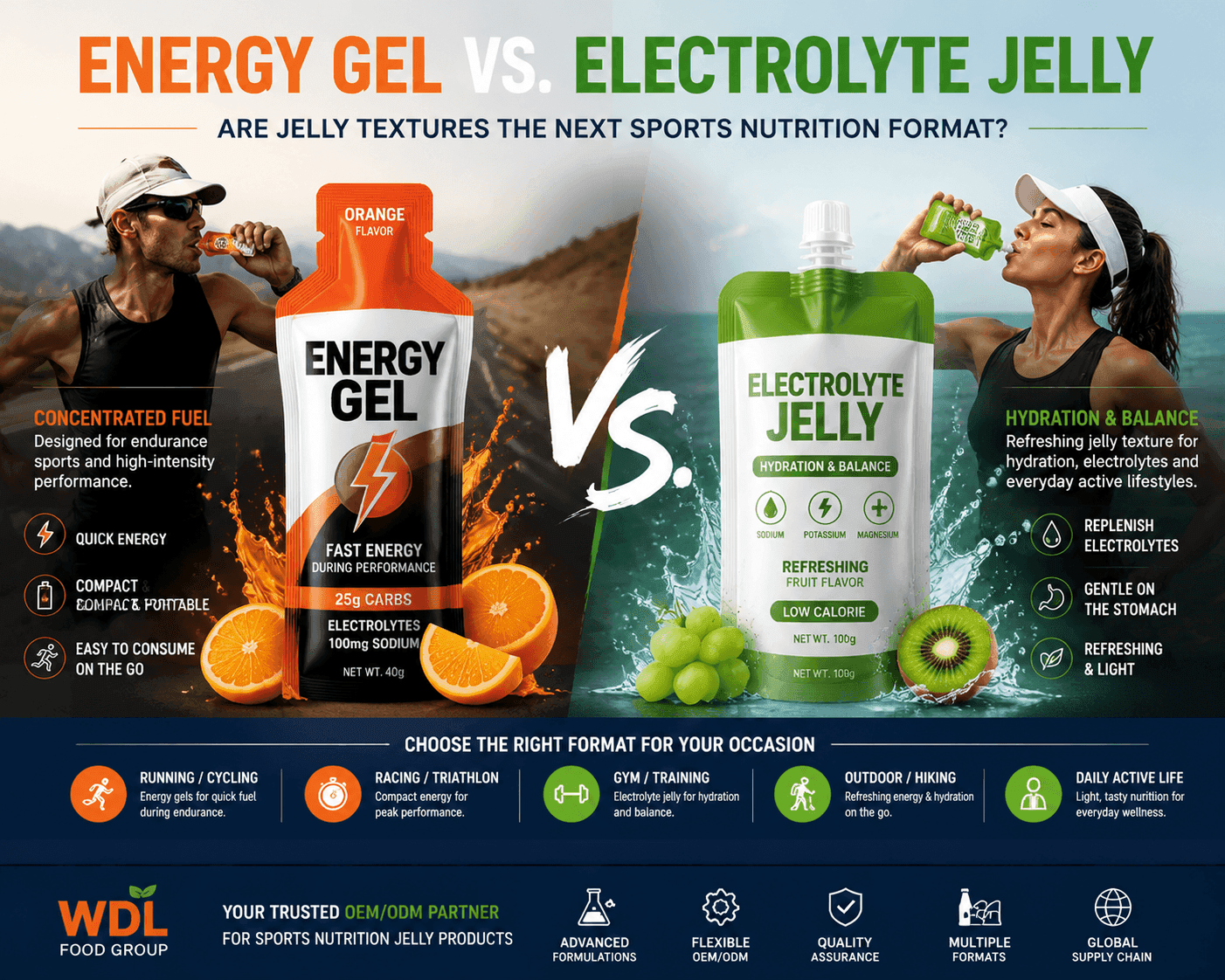
Energy gels and electrolyte jellies can both deliver nutrition in portable semi-solid formats, but they are designed around different consumer needs. Energy gels typically prioritize concentrated fueling and rapid consumption, while electrolyte or hydration jellies can create a larger, more snack-like or refreshing consumption experience.
For sports nutrition brands, that distinction is becoming increasingly relevant.
Sports nutrition is no longer limited to protein powders, bars and bottled sports drinks. Consumers now encounter nutrition through chews, shots, gels, powders, tablets and increasingly varied functional food formats.
In 2026, jelly is becoming part of that conversation.
Mintel's recent global sports and energy drink innovation review specifically identifies growing jelly textures in Asian sports and energy products and notes that jelly formats are reshaping beverage consumption.
For brands, this creates an important product-development question:
Should the next sports nutrition product be another conventional energy gel—or could a functional jelly create a different consumption occasion?
Why Are Jelly Textures Entering Sports Nutrition?
Sports nutrition products have one fundamental challenge:
They must deliver nutrition in situations where convenience matters.
A runner does not want a complicated meal halfway through training.
A cyclist needs something portable.
A gym consumer may want hydration or energy without carrying another large bottle.
That is why sports nutrition has historically developed highly convenient formats including bars, gels, chews and drink powders.
Jelly adds another option.
Food-grade gels can be engineered with different structures and flow characteristics, giving developers flexibility to create products ranging from concentrated energy gels to softer, more drinkable functional jellies.
A 2026 scientific review of food-grade gel systems described gels as emerging platforms for sports nutrition and highlighted their potential as carriers for carbohydrate, electrolytes and other nutritional components.
For commercial brands, however, the opportunity is not simply that “gel technology exists.”
The opportunity is to design a better consumption experience.
What Is a Traditional Energy Gel?
An energy gel is generally a concentrated, portable sports nutrition product designed to provide carbohydrates during endurance or other demanding activity.
Its priorities are usually straightforward:
- portable serving;
- easy opening;
- rapid consumption;
- concentrated carbohydrate delivery;
- minimal chewing.
Depending on the concept, brands may also formulate products with electrolytes, caffeine or other permitted sports-nutrition ingredients.
The package is usually small because the consumer is not looking for a conventional snack.
They are looking for fuel.
This is why energy gels have become familiar in running, cycling, triathlon and endurance sports.
What Is an Electrolyte Jelly?
An electrolyte jelly uses a jelly or soft-gel food matrix as the consumption format while incorporating selected electrolytes according to the intended formulation.
The experience can be different from a traditional energy gel.
Instead of being positioned only as concentrated fuel, an electrolyte jelly can potentially be developed around:
- hydration-oriented positioning;
- refreshing fruit flavors;
- softer jelly textures;
- larger serving sizes;
- squeezable pouches;
- recreational sports;
- outdoor activities;
- everyday active lifestyles.
This creates a wider design space.
An electrolyte jelly does not have to replace sports drinks or energy gels.
It can occupy a different consumption occasion between functional beverage, sports gel and snack.
1. Start With the Job the Product Needs to Do
Before choosing a format, ask:
What does the consumer need from this serving?
If the primary requirement is concentrated carbohydrate during a marathon, an energy gel may make sense.
If the concept is a refreshing electrolyte product for hiking, outdoor sports or active consumers, a softer squeezable jelly may create a more differentiated experience.
These products may look similar because both can come in flexible packaging.
But their commercial logic can be very different.
A useful development brief should therefore begin with the use occasion, not the package.
2. Energy Density Changes the Product Experience
Traditional energy gels are usually designed around efficient nutrient delivery in a relatively compact serving.
That creates a particular texture and flavor challenge.
When more carbohydrate or other solids are concentrated into a small serving, sweetness, viscosity and mouthfeel become important formulation considerations.
A larger jelly serving provides a different formulation environment.
It may allow brands to design something that feels more like a functional snack or refreshment rather than concentrated sports fuel.
Neither approach is automatically better.
The correct choice depends on whether the brand is designing for:
performance fueling
or
functional refreshment.
3. Texture Is Becoming a Sports Nutrition Differentiator
Texture is one reason jelly formats are commercially interesting.
Sports nutrition brands already compete heavily on:
- ingredients;
- carbohydrate systems;
- electrolyte profiles;
- flavor;
- packaging.
Texture creates another dimension.
A product could be:
Thick and concentrated
For a classic energy-gel experience.
Smooth and easy to squeeze
For convenient consumption during activity.
Soft and jelly-like
For a more snack-oriented experience.
Light and drinkable
For hydration-oriented positioning.
This means two products with similar nutritional concepts can still feel very different to consumers.
For OEM development, texture should therefore be defined alongside nutrition targets.
4. Flavor Fatigue Is a Real Product-Development Consideration
Endurance consumers may consume multiple servings during long training sessions or races.
That makes sensory experience particularly important.
Recent sports nutrition launches show brands actively expanding flavor profiles and even exploring neutral options.
In June 2026, GU Energy Labs introduced both a Passion Fruit Orange Guava flavor and a neutral “Plain & Simple” Liquid Energy option, explicitly discussing different flavor preferences during prolonged activity.
UCAN also expanded its Energy Gel + Electrolyte line in June with Strawberry Kiwi and Citrus variants for summer training and racing.
For product developers, the lesson is useful:
More sweetness is not always the answer.
Sports nutrition flavor development should consider:
- sweetness intensity;
- acidity;
- aftertaste;
- repeated consumption;
- serving temperature;
- functional ingredient taste.
A flavor that seems exciting in one bite may become tiring after several servings.
5. Electrolytes and Energy Are Not the Same Product Story
Sports products often combine hydration and energy language, but brands should define the primary function clearly.
Energy-Led Product
The central formulation question may be:
How much carbohydrate should the serving deliver?
Hydration-Led Product
The central question may instead involve:
Which electrolytes and target amounts fit the intended product concept?
Hybrid Product
Some products combine carbohydrate and electrolytes.
This can be commercially attractive, but the formulation and communication should still remain understandable.
Consumers should be able to quickly answer:
Why am I taking this product right now?
Trying to communicate energy, hydration, recovery, focus, immunity and wellness simultaneously can weaken the product story.
6. Packaging Should Follow the Sports Occasion
A compact sachet can be highly suitable for endurance fueling because it fits into pockets, belts and cycling storage.
A larger spouted pouch may make more sense for a softer electrolyte jelly intended for hiking, gym bags or outdoor activities.
Packaging decisions should consider:
- serving size;
- opening mechanism;
- one-handed use;
- squeezability;
- portability;
- product viscosity;
- branding space.
The package is not simply decoration.
During sport, it becomes part of product functionality.
7. Do Sports Nutrition Jellies Need Caffeine?
Not necessarily.
Caffeine can be relevant to certain sports nutrition concepts, but it should not automatically be included simply because a product is positioned for athletes.
Brands can develop different SKUs around different occasions.
For example:
Standard Energy Gel
Carbohydrate-focused.
Caffeinated Energy Gel
Designed for a specific performance occasion.
Electrolyte Jelly
Hydration-oriented.
Energy + Electrolyte Gel
A hybrid concept.
This portfolio approach can be clearer than trying to place every functional ingredient into one formula.
Ingredient levels, labeling and permitted claims should be assessed according to the destination market.
8. Sports Nutrition Is Expanding Beyond Elite Athletes
Another reason format innovation matters is that the sports nutrition consumer is broadening.
The category increasingly overlaps with active nutrition and everyday wellness.
FoodNavigator's 2026 sports nutrition outlook highlights functional foods and beverages, hydration and electrolyte products among important category directions, while broader industry coverage continues to emphasize convenience.
This opens opportunities beyond marathon runners and professional cyclists.
Potential consumers may include:
- hikers;
- recreational runners;
- gym users;
- team-sport participants;
- travelers;
- outdoor workers;
- active lifestyle consumers.
These groups do not necessarily want exactly the same product as an elite endurance athlete.
Jelly formats give brands room to design around those different occasions.
9. What Should a Brand Prepare Before Developing a Sports Jelly?
Before requesting samples from an OEM/ODM manufacturer, define:
Primary Function
Energy, hydration or a hybrid?
Target Consumer
Endurance athlete, gym consumer or broader active lifestyle?
Serving Size
Small concentrated sachet or larger squeezable serving?
Nutrition Target
Carbohydrate, sodium, potassium, caffeine or other required components.
Texture
Thick gel, smooth squeeze, soft jelly or drinkable jelly.
Flavor
Fruit-forward, refreshing, mild or neutral.
Packaging
Sachet, stick or spouted pouch.
Destination Market
Where will the finished product be sold?
Providing measurable targets gives an R&D team much more useful information than simply requesting a “sports jelly.”
10. Energy Gel or Electrolyte Jelly: Which Should You Choose?
Choose an energy gel when the concept centers on:
- concentrated fueling;
- endurance activity;
- compact servings;
- easy consumption during sport;
- carbohydrate delivery.
Consider an electrolyte jelly when the concept centers on:
- hydration-oriented positioning;
- a more refreshing consumption experience;
- larger or softer servings;
- active lifestyle occasions;
- differentiation from conventional sports drinks.
Consider a hybrid energy + electrolyte gel when both functions genuinely fit the target consumer and serving occasion.
The important point is that these formats should not be selected because one is currently fashionable.
The format should make the function easier for the consumer to understand and use.
Why Jelly Matters for the Next Generation of Sports Nutrition
The interesting 2026 signal is not simply that another jelly product has entered the market.
It is that sports nutrition is becoming more diverse in how nutrition is delivered.
Mintel's July 2026 innovation analysis specifically identifies rising jelly textures in Asian sports and energy drink launches, while recent food-science literature describes gel systems as increasingly versatile platforms for sports nutrition.
Together, these developments suggest that texture itself is becoming part of sports nutrition innovation.
For brands, that creates opportunities to move beyond:
powder vs. drink vs. bar
and begin asking:
What format creates the best experience for this particular sports occasion?
Developing Sports Nutrition Jelly with Victory Foods
Victory Foods develops multiple jelly and gel formats relevant to sports nutrition, including energy gels, squeezable jelly products and functional jelly concepts.
For OEM/ODM projects, development can begin with the target consumer and use occasion, followed by measurable nutrition targets, serving size, texture, flavor and packaging requirements.
The objective should not be to make another generic sports gel.
It should be to design a product where:
Function + Format + Texture + Flavor + Convenience
work together for the intended consumer.
That is where jelly can become more than an alternative package.
It can become a different sports nutrition experience.
FAQ
What is the difference between an energy gel and an electrolyte jelly?
Energy gels generally focus on compact carbohydrate delivery for sports fueling, while electrolyte jellies can be designed around hydration-oriented positioning and a softer or larger jelly experience. Exact formulations vary by product.
Can an energy gel contain electrolytes?
Yes. Some commercial sports gels combine carbohydrate and selected electrolytes. The formulation should be developed around measurable nutrition targets and the intended use occasion.
Can sports nutrition jelly be made in a spouted pouch?
A spouted pouch can be considered for suitable squeezable or drinkable jelly formulations. Package size, viscosity, serving size and intended use should be evaluated together.
Can sports jelly contain caffeine?
Caffeinated concepts may be developed where appropriate, but ingredient levels, labeling and market-specific requirements should be evaluated carefully.
Is jelly replacing traditional sports drinks?
Not necessarily. Jelly is better viewed as an additional delivery format that can create different serving sizes, textures and consumption occasions alongside drinks, powders, gels, chews and bars.