Functional Jelly Production Trial Checklist Before Mass Production
A bench sample proves a concept, but a production trial tests whether the approved formula, process and package work together at commercial scale. This checklist shows buyers what to define, observe and approve before mass production.
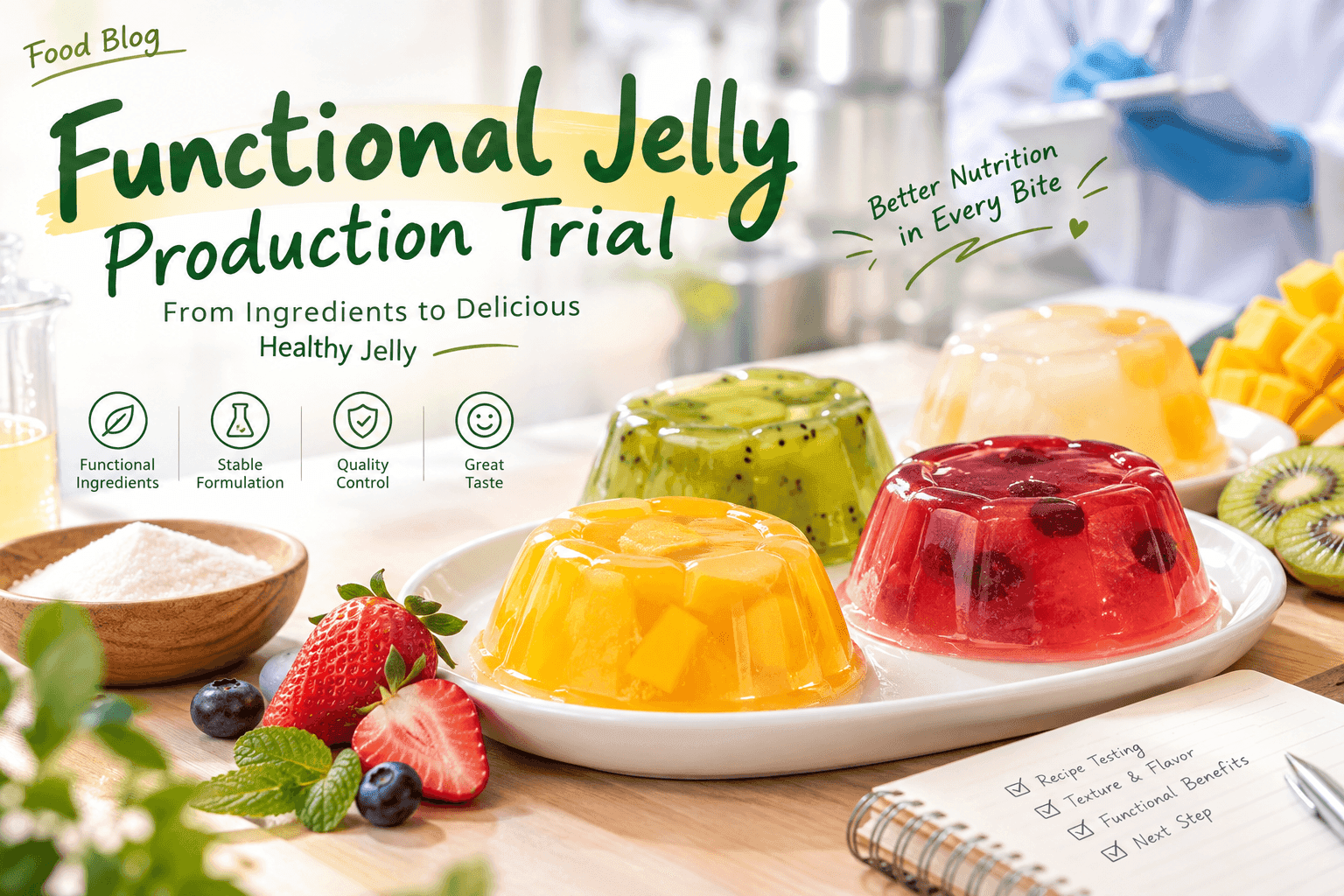
Functional Jelly Production Trial Checklist Before Mass Production
A laboratory or bench sample answers an important question: can the product concept work?
A production trial answers a different question: can the approved formula, process, package and quality plan work together under commercial conditions?
Scale changes can affect ingredient hydration, heating, mixing, hold time, flavor balance, texture, fill weight, seal cleanliness and yield. Printed packaging adds another set of variables. A product that looked correct in a hand-filled sample may behave differently on the intended line.
The goal of a production trial is not to create a ceremonial sample. It is to generate evidence for a controlled decision:
Ready for mass production + Ready with actions + Another trial required
This guide gives brands, importers, retailers and private-label project managers a practical trial-review structure. The manufacturer remains responsible for its food-safety system, process controls and production records, while the buyer should approve the agreed commercial product and project requirements.
1 Define the Purpose of the Trial
State what the run must prove.
Possible objectives include:
- scale the approved formula to commercial equipment
- confirm ingredient addition and hydration sequence
- verify target texture and flavor after processing
- establish fill and sealing settings
- confirm primary package fit
- test printed film, cups, caps or pouches
- collect shelf-life and laboratory samples
- estimate yield, waste and line rate
- train operators on a new pack-out
- verify mixed-flavor or multipack assembly
A trial cannot answer every question unless the inputs, observations and samples are planned. List the required decisions before scheduling the run.
2 Freeze the Trial Version
Create one controlled trial pack containing:
- formula code and revision
- ingredient and supplier list
target batch size
- processing instruction version
- serving size and fill-weight target
- primary and secondary packaging specifications
- artwork and code versions
- product specification and acceptance criteria
- sampling plan
- responsible reviewers
Mark any provisional item clearly. If the trial uses temporary packaging or a substitute ingredient, state which conclusions will remain open.
Do not compare the result with an unidentified sample. The approved bench reference should have its own code, storage history and decision record.
3 Confirm Raw Material Readiness
Before the run, verify that materials match the intended commercial route.
Review:
- identity and lot records
- specification and supplier status
- remaining shelf life
- storage condition
- allergen status
- premix composition and carriers
- flavor and color version
- package material and print version
- any approved substitutions
Small substitutions can affect texture, flavor, nutrition information or label declarations. A trial built from noncommercial inputs may still be useful for equipment learning, but it should not be treated as final product approval.
4 Map the Process and Decision Points
The team should understand the intended sequence before production begins.
A process map may identify:
- water and ingredient charging
- dispersion and hydration
- heating or holding stages
- mixing or shear conditions
- addition of sensitive ingredients
- acidity and flavor adjustment
- transfer and holding before filling
- filling and sealing
- cooling or setting
- coding, inspection and packing
The exact parameters are product- and process-specific. Qualified technical personnel should define the controls and acceptable values.
Identify the stages where a delay, temperature change or addition error could affect safety, legality or product quality.
5 Complete Pre Run Hygiene and Line Checks
The facility should perform its required line clearance, sanitation, allergen and pre-operational controls.
From the project perspective, confirm that:
- the correct equipment and product-contact parts are ready
- the line is cleared of previous product and packaging
- cleaning status is documented
- measuring devices needed for the run are available and checked
- coding information is approved
- sampling containers and labels are prepared
- rejected and startup material can be identified
- operators have the current instruction
FDA current good manufacturing practices address hygienic operations, facilities, equipment and production controls. The Codex General Principles of Food Hygiene provides international guidance on good hygiene practices and HACCP. The trial plan should operate within the facility's applicable system rather than create a separate informal process.
6 Observe Mixing Hydration and Hold Time
Scale-up can change how ingredients disperse and hydrate.
Record:
- actual addition order and timing
- mixing conditions used
- visible lumps, foam or incomplete dispersion
- batch temperature history
- hold time before and after key additions
- pH, solids or other agreed in-process checks
- quantity and reason for any adjustment
Do not correct the batch silently. Adjustments should be authorized, recorded and evaluated for their effect on the finished specification and label.
Compare the commercial process with the bench method. A difference may be acceptable, but it should be understood.
7 Review Filling and Sealing
The filling trial connects the product with the package.
Check:
- product behavior at the filler
- target and variation in fill weight
- startup and shutdown losses
- air inclusion or foaming
- contamination of the seal area
- seal appearance and integrity
- cap or spout application
- package deformation
- leakage or burst failures under the selected checks
- cooling or setting after filling
Flexible packs should be evaluated in their filled shape, not only as flat material. Confirm that coding, graphics and mandatory information remain readable after sealing.
Food-contact suitability must match the intended food and conditions of use. If the trial uses a different material structure from the commercial pack, keep packaging approval open.
8 Verify Product Quality During the Run
Define which observations occur at startup, during stable production and near the end of the batch.
Depending on the product, checks may include:
- appearance and color
- aroma and flavor
- texture or flow
- fill weight
- pH or soluble solids
- package seal and closure
- date and lot code
- unit count and assortment ratio
Use methods and limits approved for the project. Record results with time or sequence so the team can identify drift.
If the product requires food-safety process controls, the facility's qualified personnel must monitor and document them according to the applicable plan.
9 Compare the Trial With the Approved Sample
Condition the samples consistently before comparison.
Ask:
- Is the flavor direction equivalent to the approved target?
- Is the texture acceptable at the intended consumption temperature?
- Does the product release from the package correctly?
- Is the appearance consistent with approved expectations?
- Are differences caused by scale, process, package or sample age?
Do not force a pass because the run is complete. If the production result differs materially, document the difference and decide whether to adjust the process, revise the target or run another trial.
Approval should identify the exact trial lot and conditions.
10 Collect Retains and Shelf Life Samples
The trial can provide representative samples for later evaluation.
Prepare a sampling plan that identifies:
- number of units and sampling points
- finished-pack configuration
- lot and time identification
- storage conditions
- rest or observation schedule
- samples for the buyer, manufacturer and laboratories
- reserve samples for investigation
Shelf-life work should use the intended commercial formula, process and package whenever possible. If any element changes afterward, evaluate whether the study remains representative.
Retains should be protected from mix-ups and linked to the production record.
11 Test Coding Artwork and Pack Out
The trial should verify more than the food inside the unit.
Review:
- correct artwork version
- code content, position and legibility
- barcode placement and scannability where applicable
- primary-pack orientation
- retail-box count
- variety-pack ratio
- case count and case markings
- packaging fit and closure
- pallet or shipping configuration used for approval
Temporary white packaging cannot validate final print contrast, code readability or pack-out fit. Schedule a separate packaging trial if commercial materials are unavailable.
12 Measure Yield Waste and Capacity Carefully
A trial can support commercial planning, but early numbers may not represent steady-state production.
Record:
- input quantity
- finished acceptable units
- startup, changeover and shutdown loss
- product remaining in equipment
- packaging waste
- rework or rejected units
- observed line speed and interruptions
Explain unusual events. A short run often carries a higher loss percentage because startup and shutdown are large relative to total output.
Use the result to refine assumptions, not to promise a fixed commercial yield before the process is stable.
13 Record Deviations and Actions
Every material deviation should have an owner and disposition.
The report should state:
- what happened
- when it happened
- affected quantity or sample
- immediate correction
- evaluation of product impact
- root-cause work required
- action owner and due date
- whether another trial or review is needed
Separate an isolated execution issue from a design problem. A one-time coding error may require training or setup correction, while repeated seal contamination may require changes to product flow, equipment settings or package design.
14 Use a Clear Approval Gate
At the trial review, classify every requirement as:
- approved
- approved with a documented action before mass production
- not approved
- not evaluated
Do not hide untested items inside a general approval email.
Mass production should not begin until critical formula, process, package, label and food-safety conditions are resolved through the responsible approval system. Commercial and technical owners should understand which actions affect the purchase order or production release.
15 Issue a Post Trial Report
The report should bring together:
- objective and scope
- versions of formula, process and packaging
- actual batch and line information
- in-process and finished-product results
- sensory comparison
- packaging and coding observations
- samples collected
- yield and waste summary
- deviations and corrective actions
- approval status
- next production conditions
Attach photographs with sample or event identifiers. A report that contains only attractive finished-pack photos is not enough to support scale-up learning.
Preparing a Functional Jelly Production Trial With Victory Foods
Victory Foods China develops hydrocolloid-based formats including functional jelly, konjac jelly, squeeze jelly, freezer pops, popping boba and sports-nutrition products.
Before a project-specific production trial, buyers should align the approved sample, formula targets, serving size, primary pack, label version, secondary pack, required samples and decision criteria. The manufacturing and quality teams can then evaluate the appropriate trial plan within the applicable production and food-safety system.
Final approval should refer to the exact product and packaging versions tested, with open actions resolved before mass production.
FAQ
Is a production trial always required
The need depends on product novelty, process, package, risk, order scale and the manufacturer's change-control system. Buyers should ask what evidence will support commercial production approval.
Is a pilot run the same as mass production
Not necessarily. A trial may use commercial equipment but a shorter duration, temporary materials or additional adjustments. Record what was representative and what remains open.
What should the buyer approve after the trial
The buyer normally approves agreed commercial attributes such as product, package, artwork and assortment, while the manufacturer controls its process and food-safety records. Responsibilities should be documented.
Can shelf life be tested from a trial batch
Yes when the trial represents the intended commercial formula, process and package. If important elements change, assess whether new or supplemental work is needed.
What happens if the production texture differs from the bench sample
Document the difference, investigate the cause and decide whether to adjust the process, revise the specification or run another trial. Do not treat an unidentified difference as automatically acceptable.