
Functional Jelly Texture Brief for Private Label Product Development
Texture words such as soft, chewy or drinkable are too broad for efficient product development. This B2B guide shows brands how to translate the intended eating experience into a practical functional jelly texture brief and sample approval process.
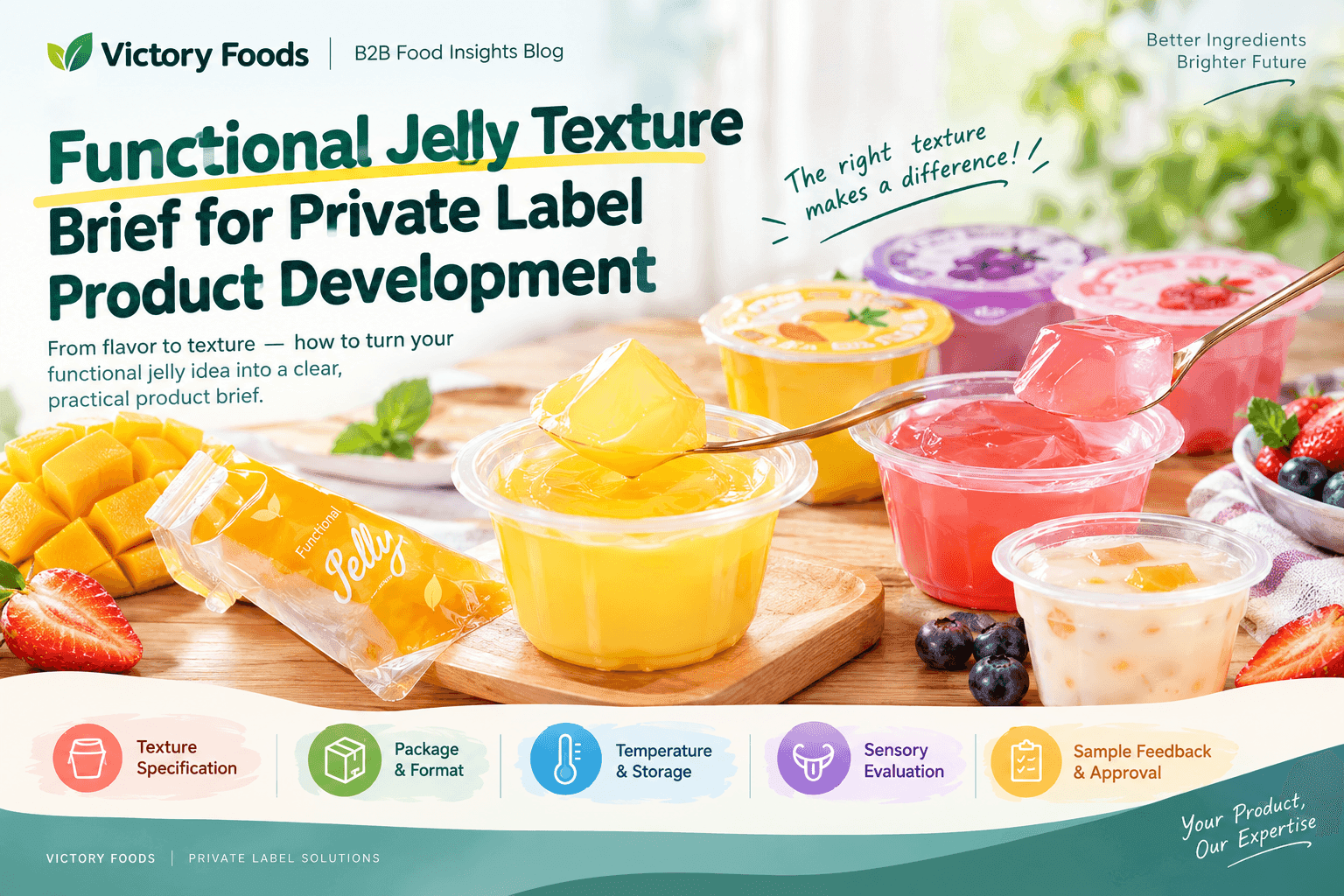
Functional Jelly Texture Brief for Private Label Product Development
Texture is one of the first things a consumer notices in a functional jelly, but it is often one of the least precisely described items in a buyer brief.
Words such as soft, chewy, smooth, thick or drinkable can mean different things to a brand manager, a formulator and a factory team. A sample may taste pleasant but still be wrong for the intended package. A jelly may squeeze easily at room temperature but become too firm after chilling. A formula may feel ideal on the first day yet change during storage.
The useful starting point is not a single texture adjective. It is a complete product experience:
Consumer + Eating occasion + Package + Temperature + Target behavior + Shelf-life expectation
This guide helps private-label brands, importers and retailers turn that experience into a practical functional jelly texture brief. It does not prescribe one hydrocolloid system or a universal measurement. The manufacturer should select and validate the formulation and process for the actual product.
1 Start With the Consumption Format
Define how the consumer will access and eat the product.
A jelly stick may be torn open and squeezed directly into the mouth. A spouted pouch may need to flow through a cap opening with light hand pressure. A cup may be eaten with a spoon or consumed as a bite-sized piece. A freezer pop may be stored and shipped in one condition but eaten after freezing.
Record:
- primary package format and opening
- serving size and number of bites or squeezes
- intended consumption temperature
- whether the product should hold shape or flow
- whether chewing is expected
- whether particles, pearls or inclusions are present
- intended consumer and use occasion
Texture cannot be separated from package geometry. A product that works in a wide cup may not pass cleanly through a narrow spout.
2 Replace Adjectives With Observable Behavior
Instead of asking only for a soft jelly, describe what the product should do.
Useful observations include:
- releases from the package without excessive force
- holds together when bitten
- does not break into unwanted fragments
- spreads or flows at a controlled rate
- leaves limited residue in the package
- feels smooth rather than grainy
- recovers or relaxes after squeezing
- remains consistent from the first portion to the last
Add unacceptable outcomes as well. Examples may include rubbery bite, watery separation, stringiness, cap blockage, excessive stickiness or a product that collapses before consumption.
This language gives the technical team a clearer target than a broad lifestyle word.
3 Use Benchmarks Carefully
A physical benchmark can help align the team, but it should be documented.
Record the benchmark brand, product name, lot, purchase date, storage condition and temperature at evaluation. Explain which feature should be matched and which features should not.
For example, the buyer may want the easy squeeze of one pouch but a cleaner finish, lower sweetness and firmer bite. Saying "make it like this product" without that explanation can create confusion.
Do not assume that a commercial benchmark can be copied exactly. Its ingredients, process, package and legal position may differ. Use it as a sensory reference, not as a substitute for a product specification.
4 Define Temperature Conditions
Temperature can materially change the way a jelly flows, deforms and feels in the mouth.
Evaluate samples under the conditions that matter to the project:
- room-temperature storage and consumption
- chilled consumption
- warm-climate handling
- freeze-at-home use
- the product shortly after opening
State the conditioning time before evaluation. A sample removed from a refrigerator five minutes earlier is not equivalent to one held at room temperature for several hours.
If the product will be sold in several climates, the development plan may need more than one evaluation condition.
5 Connect Texture With the Formula System
Functional jelly texture results from an interacting system rather than one ingredient.
Water level, hydrocolloid selection, solids, sugars or sweeteners, acids, salts, proteins, fibers and active ingredients can all affect hydration, gel formation, flow and mouthfeel. Processing order, temperature, shear, hold time and cooling can also change the result.
The buyer does not need to design the technical system, but the brief should disclose the commercial requirements that constrain it:
- zero-sugar or reduced-sugar target
- vegan or other ingredient-positioning requirement
- vitamin, mineral, collagen, fiber, botanical or electrolyte targets
- pH or flavor direction
- particles or inclusions
- storage and shelf-life target
- package and filling route
Treat formula and texture approval as linked decisions. A late change to the active ingredient level or sweetener system may require another texture review.
6 Account for Flavor and Mouthfeel Together
Texture changes how sweetness, acidity, aroma and aftertaste are perceived.
A thicker product may hold flavor differently from a more fluid one. High mineral levels can affect taste and may influence the way the formula is balanced. Fibers or proteins can add body, dryness or coating sensations. Acids can affect both flavor and the technical system.
Evaluate flavor in the final target texture rather than approving flavor in a liquid base and assuming it will transfer unchanged.
Use one feedback sheet for texture and flavor so the team can see tradeoffs. If a sample is firmer but less aromatic, record both changes instead of approving one characteristic in isolation.
7 Include Package Interaction in Sample Review
The same formula can feel different when delivered from a cup, stick or pouch.
Check:
- squeeze force and flow through the opening
- product left in corners or seals
- cap or spout blockage
- seal contamination during opening
- product shape after release
- spoonability or bite size
- consumer control over portion delivery
Use production-representative packaging when the project is mature enough. A laboratory cup is useful for early formulation work but cannot validate the experience of a narrow stick or spouted pouch.
Food-contact materials must also be suitable for the intended food and condition of use. Packaging evidence should be confirmed for the destination market and actual construction.
8 Build a Controlled Sensory Evaluation
Sensory review should be repeatable enough to support a decision.
ISO 6658 provides general guidance on sensory analysis methodology. The appropriate method depends on whether the team is describing a product, detecting a difference, measuring preference or confirming acceptability.
For an internal development review:
- assign blind sample codes where useful
- serve samples in a controlled order
- standardize temperature and portion
- define the attributes before tasting
- use the same scale across rounds
- collect comments before group discussion
- record evaluator role and date
- separate objective observations from personal preference
A founder's preference can inform the brand direction, but it should not be presented as universal consumer evidence.
9 Add Simple Instrumental Checks Where Useful
Instrumental measurements can support consistency, but they do not replace the eating experience.
Depending on the product and equipment, the technical team may monitor measures related to flow, firmness, deformation, extrusion force, fill weight or dimensional stability. The method, sample preparation, temperature and timing must be defined; otherwise, numbers from different rounds may not be comparable.
Ask the manufacturer which measurements are useful for the chosen format and what variation is realistic in commercial production.
Avoid placing an arbitrary number in the specification only because it looks precise. A measurement is valuable when it links to product performance and can be reproduced.
10 Evaluate Texture Over Time
Day-one approval is not the end of texture development.
During storage, a jelly may firm, soften, release liquid, become grainy, lose shape or interact with the package. The rate can depend on formula, process, temperature, light and packaging barrier.
Include texture observations in the shelf-life plan. Evaluate relevant checkpoints using the same conditioning and method. If accelerated studies are used, confirm what they can and cannot predict for the actual product.
Retain samples from representative production so later observations can be traced to a lot and process record.
11 Define Acceptance and Tolerance
A useful specification identifies both the target and acceptable variation.
For each important attribute, state:
- target description
- unacceptable condition
- evaluation method
- test temperature and timing
- reference sample or approved range
- decision owner
The acceptance criteria should reflect what consumers and the package can tolerate, not an unrealistic expectation that every unit will feel identical.
Separate critical failures from preferences. A blocked spout or leaking seal is different from a small change in chewiness that remains within the approved sensory range.
12 Give Actionable Sample Feedback
Avoid feedback such as "not premium enough" or "make it better."
Use comments that identify direction and priority:
- reduce the initial squeeze force
- increase shape retention after release
- decrease surface stickiness
- keep the current acidity while reducing graininess
- preserve the approved flavor but create a cleaner finish
- maintain the current texture after chilling
State which sample is the reference and whether the next round should change one variable or several. Uncontrolled changes make it difficult to learn from the comparison.
13 Approve the Right Version
The approved sample should have an identifiable formula, process, package and evaluation record.
Before approval, confirm:
- sample code and formula version
- ingredient and functional target version
- processing notes
- primary package used for evaluation
- serving size and fill weight
- storage history
- texture and flavor decision
- open actions or conditions
- approver and date
If the formula, package or process changes during scale-up, decide whether the approval remains valid or another sample is needed.
Developing Functional Jelly Texture With Victory Foods
Victory Foods China develops hydrocolloid-based products including functional jelly, konjac jelly, squeeze jelly, freezer pops and sports-nutrition formats for international markets.
Brands can support an efficient development discussion by providing the target market, consumer, eating occasion, package, serving size, ingredient goals, benchmark, temperature condition and desired product behavior. The technical team can then evaluate formulation and process feasibility for the project.
Final texture, stability, packaging and market suitability should be confirmed through approved samples, production-representative trials and project-specific validation.
FAQ
What is the best texture for a functional jelly
There is no universal best texture. The target depends on the consumer, package, serving size, use occasion, temperature, formula and brand position.
Why does a jelly feel different after chilling
Temperature can change flow, firmness and sensory perception. Evaluate the product at the intended consumption temperature and define the conditioning method.
Can a benchmark product be copied exactly
A benchmark can communicate direction, but its formula, process, package and legal position may differ. Identify the specific attributes to reference rather than requesting an exact copy.
Should texture be measured by instruments or tasting
Both can be useful. Instrumental checks can support consistency, while sensory review confirms the actual eating experience. Methods and sample conditions must be controlled.
When should texture be reapproved
Review again after material changes to formula, active ingredients, sweeteners, process, serving size, package, storage route or another factor that could affect product behavior.